

It was a priviledge to write a guest post for Teacher Types recently with my "Tummy Time Tips"! There are four tips to help new parents get started with tummy time! Here is a sneak peak... “Back to sleep, tummy to play” was coined as a response to encouraging parents to lay their babies to sleep on their back to help reduce the risk of SIDS- Sudden Infant Death Syndrome or "cot death". Tummy time encourages a baby with the development of head, neck and upper body muscles. This development is so important as baby learns to roll over, sit up, crawl, stand and walk. All these activities need baby to have the strength to support themselves against gravity and develop postural tone. Tummy time helps them to understand how to weight-shift and over time use both arms at the same time (bilateral coordination). Weight bearing on baby’s arms and hands is an important benefit of tummy time and crawling that can be sometimes overlooked. Tummy time also helps to prevent the development of flat areas on the back of their head. Please head over to Teacher Types to read these tips as I encourage you to consider the time baby spends on their tummy as enjoyable and an opportunity for parent and child interaction. Read it in full here! 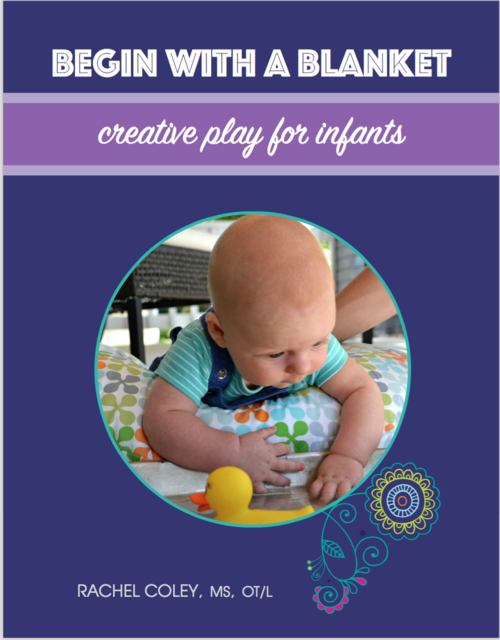
Looking for more information about "tummy time"?
What tips do you give new parents about tummy time? 

Cindy is a registered Occupational Therapist practising in Sydney Australia. She has two young children who are a constant source of inspiration and learning. Cindy loves working creatively to help children to reach their potential, finding opportunities in everyday living and making learning fun. Cindy is the author of the Occupational Therapy blog Your Kids OT.
The information on this site is general in nature. The activities are safe for most children, however, you should consult an Occupational Therapist or health professional to address specific movement, sensory or other medical conditions. Comments are closed.
|
AuthorHi, I'm Cindy and I am an Occupational Therapist. I enjoy working creatively with children to see them reach their potential. Read more about me here. 
SEARCH THIS SITE
Archives
June 2024
Categories
All
Popular Posts
 |
 RSS Feed
Join the YKOT e-newsletter!
Subscribe to get our latest content by email and receive
the SHAPE ROADS PRINTABLE NOW!

Join our Mailing List!
Subscribe to get our latest content by email and receive
the SHAPE ROADS PRINTABLE NOW as a thankyou!
Disclaimer: The information on this site is general in nature and should be used for educational and entertainment purposes. The activities are safe for most children, however, you should consult an Occupational Therapist or health professional to address specific movement, sensory or other medical conditions. This blog does not replace formal therapeutic professional advice given by a health professional or medical practitioner. Reviews and endorsements of products will only be made based on my expertise and personal opinion; and deemed worthy of such endorsement. The opinions shared in sponsored content will always be my own and not that of the advertising company or brand. Content, advertising space or posts will be clearly identified if paid, affiliated or sponsored. Affiliate links may be found throughout this website in advertising. This means that if you follow through with a purchase from these links, Your Kids OT will receive a percentage of the sale. Your Kids OT undertakes to meet the requirements of the "Social Media Policy" as published by Australian Health Practitioner Regulation Agency (AHPRA). Further information about this policy can be found here.
Find meFollow me |
|
About me
AuthorHi, I'm Cindy and I am an Occupational Therapist. I enjoy working creatively with children to see them reach their potential. Read more about me here. 
|
Copyright © 2017 Your Kid OT