|
There are two different "letter families" that I use. Letter families are groups of letters taught at the same time for a specific purpose. I have grouped these letter families when teaching to write NSW Foundation Font lowercase letters in print. NOTE: This blog post will focus on letter families. There are a few references in this blog to look out for future posts about activities that may be done to encourage learning letter families. There is just too much information for one post about this!! Thanks for your patience. Let me introduce you to the first letter family {Magic C letters, Line letters and the odd ones out}. I use this letter family when introducing or focusing on letter formation. Magic C letters are written with the "C" component drawn first during letter formation. Line letters are written with the "line" component drawn first during letter formation. I further categorise these letters according to size teaching tall lines, short lines and then the tail lines. Odd ones out are letters that have no common features. 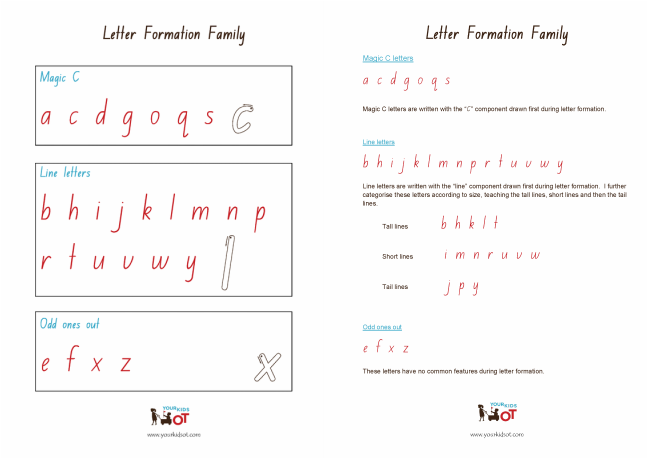
Once letter families are introduced to children, I use several activities to help children classify the letters into the aforementioned groups. This may include sorting out flashcards into piles, using magnetic letters to put groups on different boards, completing a find a word puzzle of one category of letters, etc. Future posts will have photographs and further descriptions. The letters in the second letter family are based on size {small, tall and tail letters}. Look out for future posts for suggestions to work on letter size. 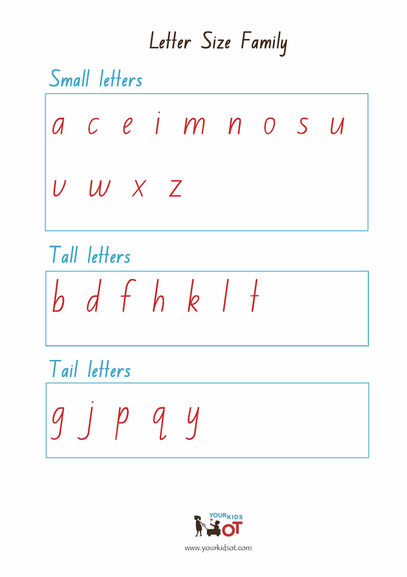 Why letter families? 1) Letter families help children to "group" or "classify" letters. With the letter formation family - children group the letters not only in the way they look but also according to the first motor action it takes to write the letter {eg. draw a line down). This in turn, helps children to plan when writing as they can visualise what they need to do. With the letter size family - children group the letters in relation to each other [eg. tall letters are twice the height of small letters}. This again helps with planning and visualisation for writing. 2) The letter formation family may help with classification of common letters that children "reverse" such as"b" and "d". In this instance, children learn that "b" is a line letter so the line is drawn first. "d" is a magic c letter so the "c" is drawn first. 3) The letter size family can remind children of a letter's "starting point" when writing. For all "tall letters" start up high (with one exception being d). 4) Letter families help children with legibility and neatness. Do you use letter families? What letter families work for your children?
cate Hong
18/6/2014 12:41:26 pm
Hi Cindy, Comments are closed.
|
AuthorHi, I'm Cindy and I am an Occupational Therapist. I enjoy working creatively with children to see them reach their potential. Read more about me here. 
SEARCH THIS SITE
Archives
June 2024
Categories
All
Popular Posts
 |
 RSS Feed
Join the YKOT e-newsletter!
Subscribe to get our latest content by email and receive
the SHAPE ROADS PRINTABLE NOW!

Join our Mailing List!
Subscribe to get our latest content by email and receive
the SHAPE ROADS PRINTABLE NOW as a thankyou!
Disclaimer: The information on this site is general in nature and should be used for educational and entertainment purposes. The activities are safe for most children, however, you should consult an Occupational Therapist or health professional to address specific movement, sensory or other medical conditions. This blog does not replace formal therapeutic professional advice given by a health professional or medical practitioner. Reviews and endorsements of products will only be made based on my expertise and personal opinion; and deemed worthy of such endorsement. The opinions shared in sponsored content will always be my own and not that of the advertising company or brand. Content, advertising space or posts will be clearly identified if paid, affiliated or sponsored. Affiliate links may be found throughout this website in advertising. This means that if you follow through with a purchase from these links, Your Kids OT will receive a percentage of the sale. Your Kids OT undertakes to meet the requirements of the "Social Media Policy" as published by Australian Health Practitioner Regulation Agency (AHPRA). Further information about this policy can be found here.
Find meFollow me |
|
About me
AuthorHi, I'm Cindy and I am an Occupational Therapist. I enjoy working creatively with children to see them reach their potential. Read more about me here. 
|
Copyright © 2017 Your Kid OT