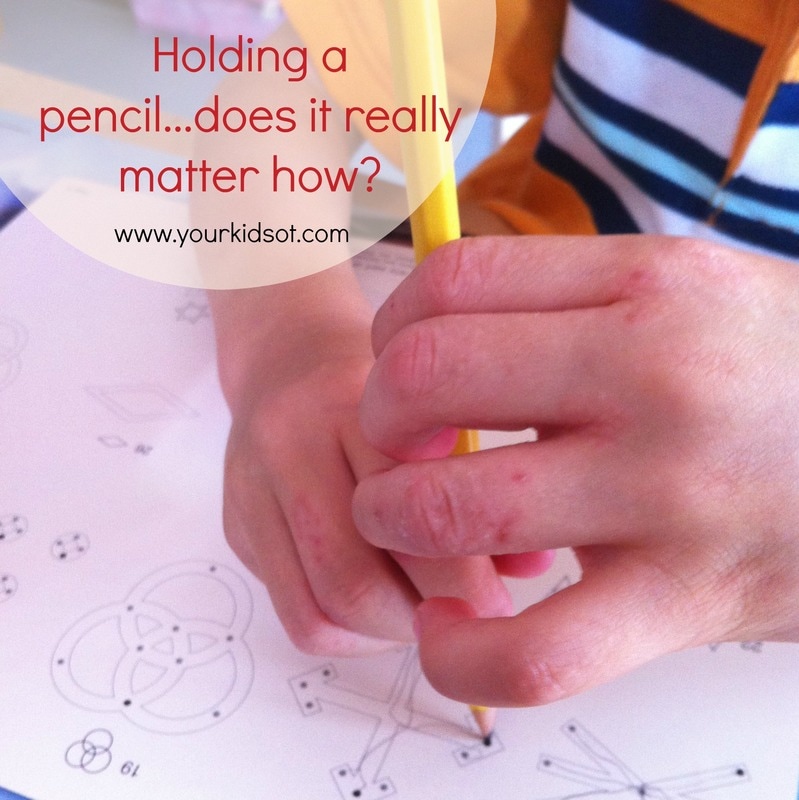
 A tripod grasp doesn’t tell you the whole story. When we look at a child’s pencil grasp, it’s easy to focus on the fingers: Is the thumb in the right place? Are they using three fingers? Does it look like a tripod grasp? But there’s much more to pencil control than the position of the fingers. In fact, four children can appear to have almost the same tripod grasp while using very different strategies to control their pencil. In all four of these photographs, I’m actually “holding” the pencil with the same fingers. So all grasps are technically called “tripod grasps” with the thumb, index and third fingers holding the pencil. But where is the movement coming from? Are the fingers moving independently? Is the wrist stable? Is the hand working as one unit? Are the wrist and forearm supported? And what is happening further up the arm and through the shoulder? This is why, whenever I talk about pencil grasp, I also talk about pencil control. This principle of proximal stability supporting distal mobility becomes important. So let's take a closer look at these four examples.  1. Static or Dynamic Tripod Grasp. These grasps can look the same when just looking at the fingers. The wrist and forearm are supported on the table. Dynamic movement means the pencil is controlled by pushing and pulling (flexion and extension) of finger movements. Static control comes from movement of the whole arm as one unit.  2. A hooked wrist indicates poor wrist stability. The fingers are working hard to grip the pencil but movement is coming from the wrist. Sometimes the movement is coming from the elbow with the forearm and hand pulling along the page during writing and drawing. It is really important for these children to work on upper limb strength and wrist stability. Lots of work on a vertical surface, weight bearing on the forearm and arms (eg. monkey bars, wheelbarrows, animal walks), pulling activities (eg. tug of war, pulling a wagon), carrying loads such as buckets of sand or water and scooter board activities.  3. The fingers here are flatter with a closed webspace. The pencil leans along the index finger for support and movement is with the whole hand as one unit often due to finger joint laxity (hypermobility). Pencil grips can really help these kids! These children benefit from fine motor skill activities to build finger strength, separation of the two sides of the hand, strong palmar arches and in-hand manipulation skills. Read here for more information.  4. The whole wrist and forearm are unsupported off the table. This is developmentally appropriate for young child 3-4 years. If this is seen in an older child, it means that they haven’t developed stability of their shoulder, elbow and wrists. Read more about developmental progression of pencil grasp HERE. Pencil grasp is always observed as part of a handwriting assessment or motor skills assessment. I typically use the DASH (Detailed Assessment of Speed of Handwriting), The McMasters Handwriting Protocol, the Bruininks-Oseretsky Test of Motor Proficiency – Third edition (BOT-3), the Movement Assessment Battery for Children – Third edition (MABC-3) or the Miller Functional and Participation Scales (MFUN). These assessments are all missing something. They may ask you to observe pencil grasp but there may be no guidance for recording "pencil control". These assessments also do not provide guidance for how to describe "unusual" or "unique grasps". OTs are interested in describing grasps so that teachers and parents understand if the grasp is functional, developmentally appropriate, affecting legibility, speed, pain or fatigue. We created a Pencil Grasp Evaluation Form in Gripipedia for this reason! We help occupational therapists to know what "clinical observations" to make and how to write a description when you are seeing an atypical grasp. Gripipedia is your guide to pencil grips and grasp. It is full of practical tips and you will refer to it time and time again.
 Thank you to everyone who has purchased Gripipedia and the amazing feedback that we have received. This latest testimonial from Dave Jereb, OT was really humbling to receive. Until next time, Cindy 
0 Comments
Your comment will be posted after it is approved.
Leave a Reply. |

About me...Hi, I'm Cindy ... an Occupational Therapist who enjoys working creatively with children. We work on client-centred principles of respect, connection, regulation before expectation, meeting sensory needs, active engagement and participation, Read more about me here. 

SEARCH THIS SITE

Click to set custom HTML
Archives
October 2026
Categories
All
Popular Posts

 |


 RSS Feed
Disclaimer: The information on this site is general in nature and should be used for educational and entertainment purposes. The activities are safe for most children, however, you should consult an Occupational Therapist or health professional to address specific movement, sensory or other medical conditions. This blog does not replace formal therapeutic professional advice given by a health professional or medical practitioner. Reviews and endorsements of products will only be made based on my expertise and personal opinion; and deemed worthy of such endorsement. The opinions shared in sponsored content will always be my own and not that of the advertising company or brand. Content, advertising space or posts will be clearly identified if paid, affiliated or sponsored. Affiliate links may be found throughout this website in advertising. This means that if you follow through with a purchase from these links, Your Kids OT will receive a percentage of the sale. Your Kids OT undertakes to meet the requirements of the "Social Media Policy" as published by Australian Health Practitioner Regulation Agency (AHPRA). Further information about this policy can be found here.
Find meFollow me |

|
About me
AuthorHi, I'm Cindy and I am an Occupational Therapist. I enjoy working creatively with children to see them reach their potential. Read more about me here. 
|
Copyright © 2025 Your Kid OT