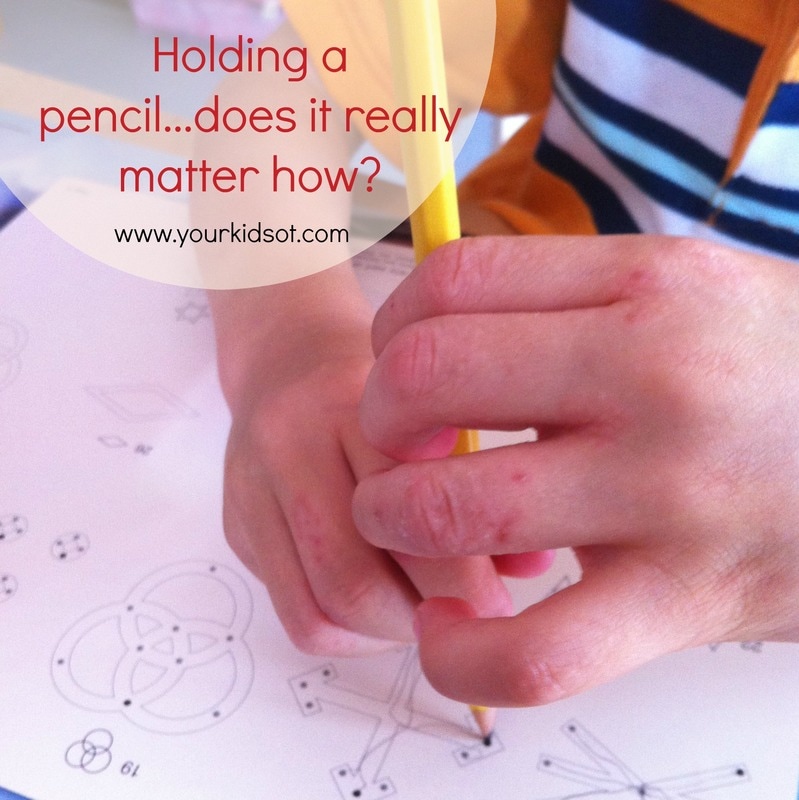
 When we look at a child's pencil grasp, it can be tempting to focus on what the fingers are doing. Is it a tripod grasp? A quadrupod? A lateral grasp? Is the pencil being held “correctly”? But pencil grasp is only one piece of the puzzle. As occupational therapists, we need to consider the bigger picture: the child, the task and the environment and how all of these factors come together to influence pencil control, handwriting and participation. I've been sharing about these concepts over a number of years. Here are some of the pieces of the puzzle worth considering. 🧩 Pencil grasp and control
Read: Losing Pencil Control. Pencil Grasp Does Matter!
Read: What If My Child Can't Use a “Normal” Pencil Grasp? Should I Change It? 🧩 Furniture and environment
Read: Size Matters: Furniture Fit for Function
Read: The Why and How of Vertical Surfaces 🧩Posture & Body Stability Gross Motor Skills Needed for Page Stabilization During Writing Core strength, bilateral coordination and shoulder stability, influence handwriting and pencil control. They are needed to help with page stabilisation during handwriting tasks. Read: Gross Motor Skills Needed for Page Stabilization 🧩 Hand function for self-care Hands don't only have to manage pencils! The same developing hand skills are used across many everyday occupations, including managing buttons, zips, fasteners, cutlery, toothbrushes and other self-care tools. If a child has difficulty with pencil control, they often have difficulty with these self-care tasks. Typing is not always the quick solution either.
Read: Fine Motor Skills with a Marble (or Ball)!
🧩 Handwriting legibility Ultimately, pencil grasp is not the end goal. We want to consider what the child can do with the pencil. Can they form letters? Are letters an appropriate size? Is spacing consistent? Can they maintain alignment? Can someone else read what they have written?
Read: Orthography, Handwriting Legibility and OT
Read: Top Tips for Teaching Handwriting   🧩 Visual Motor Integration skills Handwriting also relies on visual and visual-motor integration skills. Children need to take in visual information, remember it, organise it in space and translate what they see into written output.
Read: Visual Perceptual Skills Required for Handwriting 🧩 Task demands Writing one sentence on a whiteboard is different from copying a paragraph. Writing a name is different from completing a page of written work. Writing for five minutes is different from writing for thirty minutes. The length, speed, complexity and purpose of the task can all change the demands placed on the child.
Read: Everyday Writing… Encouraging Reluctant Writers 🧩 Endurance and fatigue Sometimes a child's pencil grasp looks perfectly manageable at the beginning of a task but changes as the task continues.
Putting the pieces together This puzzle is far from complete! There are many other factors that can influence how a child approaches and participates in a handwriting or pencil task. Bilateral integration helps a child coordinate both sides of the body, including using one hand to stabilise the paper while the other writes. Crossing the midline can influence how a child moves across the page and maintains an efficient working position. Attention and executive functioning can affect the ability to stay engaged, remember instructions, plan what to write and manage multiple demands at once. Motivation, interest and engagement matter too. A child may demonstrate very different skills depending on how meaningful, challenging or enjoyable the task is. Sensory needs, regulation, motor planning, learning differences and the individual context of the child can also become important pieces of the puzzle. When we're trying to understand a child's pencil use or handwriting, we need to consider the whole picture:
Would you like to explore pencil grasp and control further? Gripipedia: Your Guide to Pencil Grips and Grasp is a practical resource for OTs, educators and others who want to better understand pencil grasp, evaluate pencil use and make informed decisions about when and how to intervene. Watch the unboxing of the book! Gripipedia is now on sale! 
0 Comments
Your comment will be posted after it is approved.
Leave a Reply. |

About me...Hi, I'm Cindy ... an Occupational Therapist who enjoys working creatively with children. We work on client-centred principles of respect, connection, regulation before expectation, meeting sensory needs, active engagement and participation, Read more about me here. 

SEARCH THIS SITE

Click to set custom HTML
Archives
September 2026
Categories
All
Popular Posts

 |


 RSS Feed
Disclaimer: The information on this site is general in nature and should be used for educational and entertainment purposes. The activities are safe for most children, however, you should consult an Occupational Therapist or health professional to address specific movement, sensory or other medical conditions. This blog does not replace formal therapeutic professional advice given by a health professional or medical practitioner. Reviews and endorsements of products will only be made based on my expertise and personal opinion; and deemed worthy of such endorsement. The opinions shared in sponsored content will always be my own and not that of the advertising company or brand. Content, advertising space or posts will be clearly identified if paid, affiliated or sponsored. Affiliate links may be found throughout this website in advertising. This means that if you follow through with a purchase from these links, Your Kids OT will receive a percentage of the sale. Your Kids OT undertakes to meet the requirements of the "Social Media Policy" as published by Australian Health Practitioner Regulation Agency (AHPRA). Further information about this policy can be found here.
Find meFollow me |

|
About me
AuthorHi, I'm Cindy and I am an Occupational Therapist. I enjoy working creatively with children to see them reach their potential. Read more about me here. 
|
Copyright © 2025 Your Kid OT