
Christmas is coming and its time to incorporate some fun activities for kids into OT sessions. You could easily do these at home too!
​ Each activity requires just a few supplies. Feel free to substitute items with what you have available! 1. Christmas Pipe Cleaner Wand You will need: * A craft stick * A Pipe Cleaner * A Muffin Tray * Pom Poms * Another tray or bowl Preparation - what to do: * Ask your child to wind the pipe cleaner around the craft stick. * Ask your child to create a circle at the top of the stick to act as a "scoop". * Place a pom pom in each muffin tray hole. Activity - what to do: * Ask your child to use their wand to scoop each pom pom and transfer to tray or bowl. Alternative is to use the wand like an "egg and spoon" race to carry annd transfer the pom pom across the room. Activity benefits: * Encourage bilateral coordination. * Encourage motor planing. * Encourage eye-hand coordination. * Encourage crossing the midline (dependent on where you place the tray). 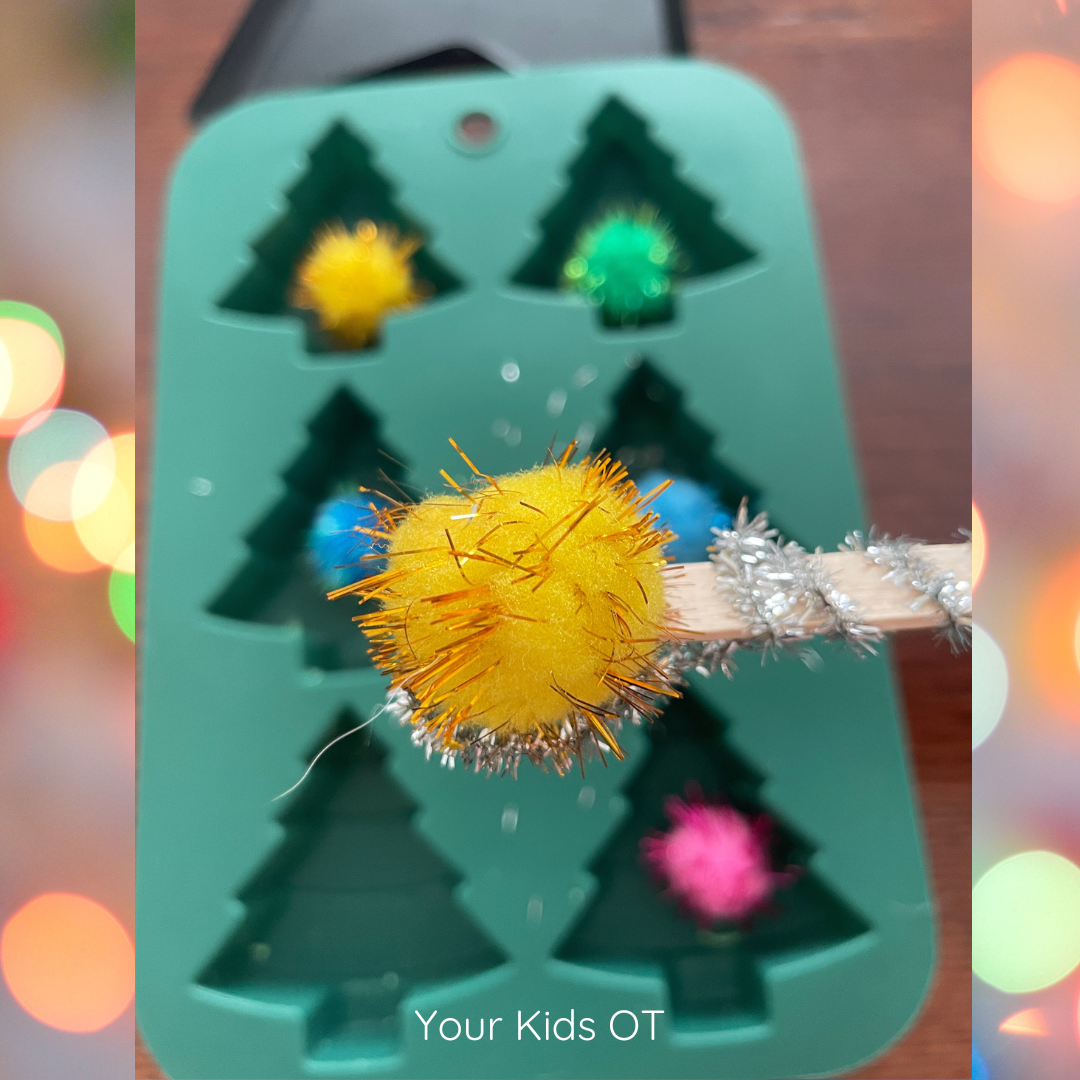
2. Stacking Christmas Cups.
​ You will need: * 10 paper cups Preparation - what to do: * None! Activity - what to do: * Ask your child to stack the cups in a pyramid (4, 3, 2, 1). Alternative is to race a timer or race another person. Activity benefits: * Encourage bilateral coordination. * Encourage motor planing. * Encourage eye-hand coordination. * Encourage crossing the midline. 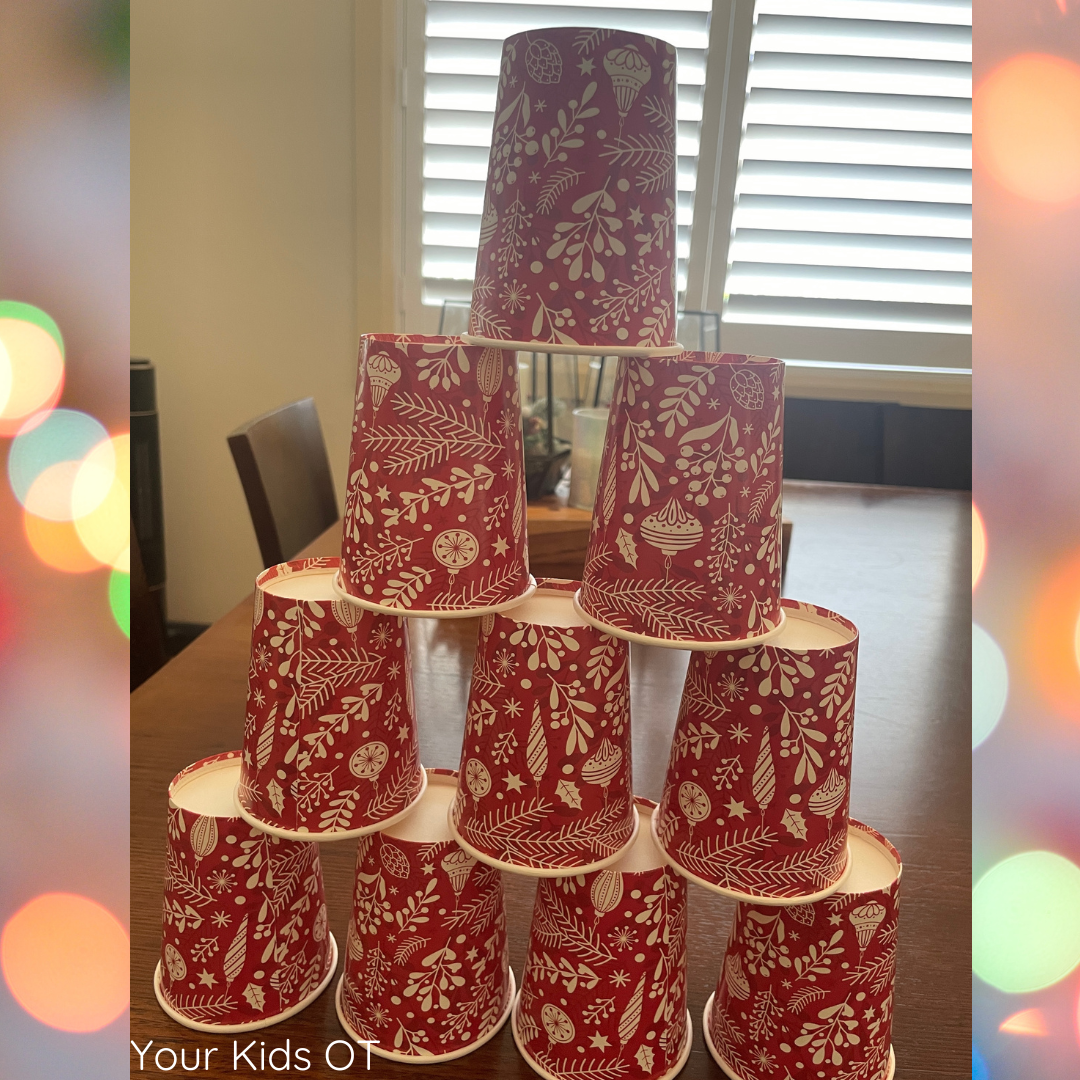
3. Elf Rescue
You will need: * An elf on a small sled (or a small toy in a cardboard box). * A toilet paper roll. * A piece of wool. Preparation - what to do: * Attach the wool to the toilet paper roll on one end and sled on the other end. * Secure the elf to the sled. * Optional pain the toilet paper roll. Activity - what to do: * Ask your child to hold the toilet paper roll and wind up the wool to rescue the elf. Activity benefits: * Encourage bilateral coordination. * Encourage motor planing. * Encourage eye-hand coordination. * Encourage crossing the midline. 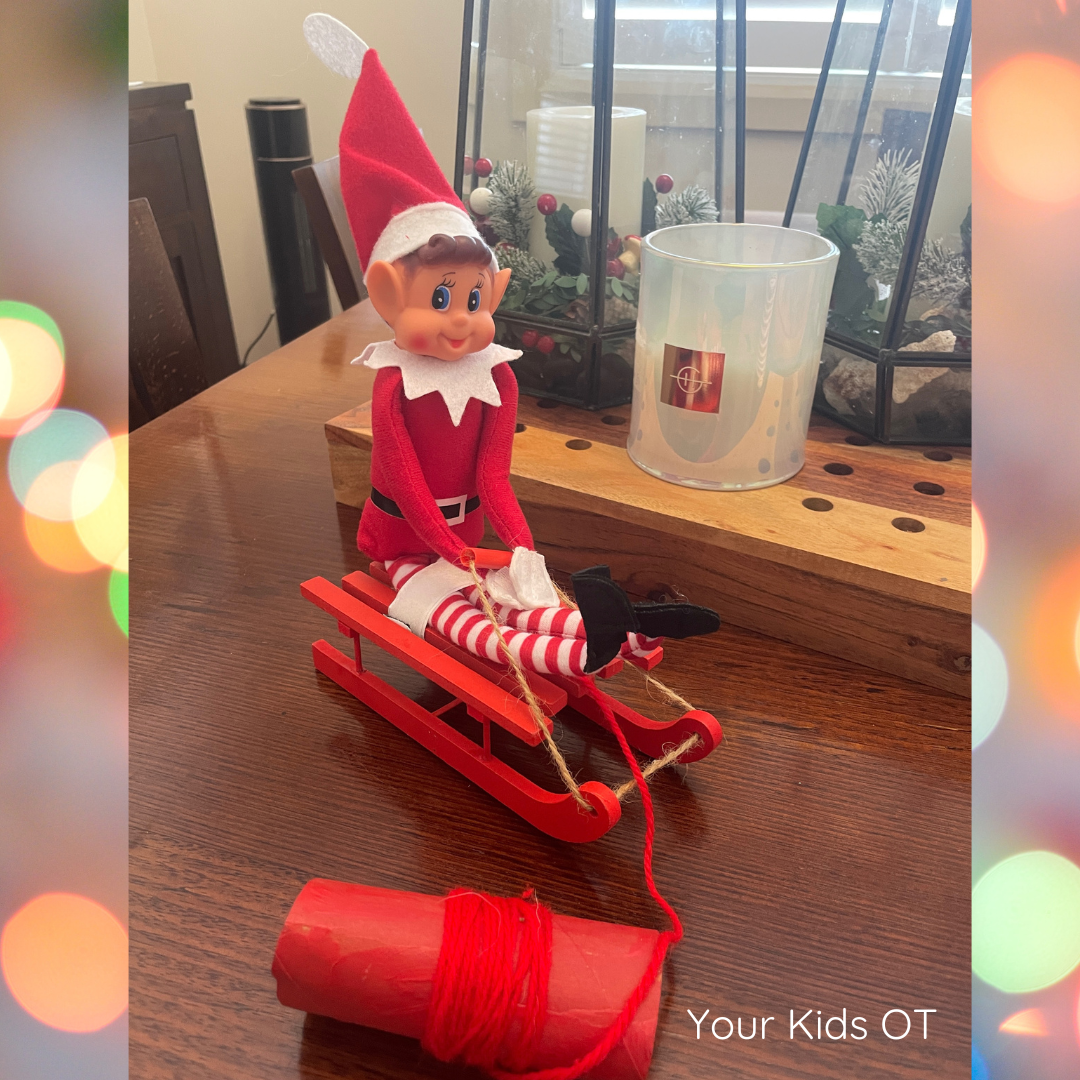
4. Christmas Card Puzzles!
You will need: * Christmas cards or gift tags. * Scissors ​* Optional - magnets Preparation - what to do: * Cut the Christmas cards or gift tags into the desired number of pieces. * Optional - attach magnetic paper to the back of the cards. Activity - what to do: * Ask your child to match the pieces together to create the picture. The difficulty can be varied depending on the number of puzzle pieces cut and with how complicated the pictures are on the cards. Activity benefits: * Encourage visual spatial awareness. * Encourage visual discrimination. * Encourage visual closure skills. * Encourage problem solving skills. 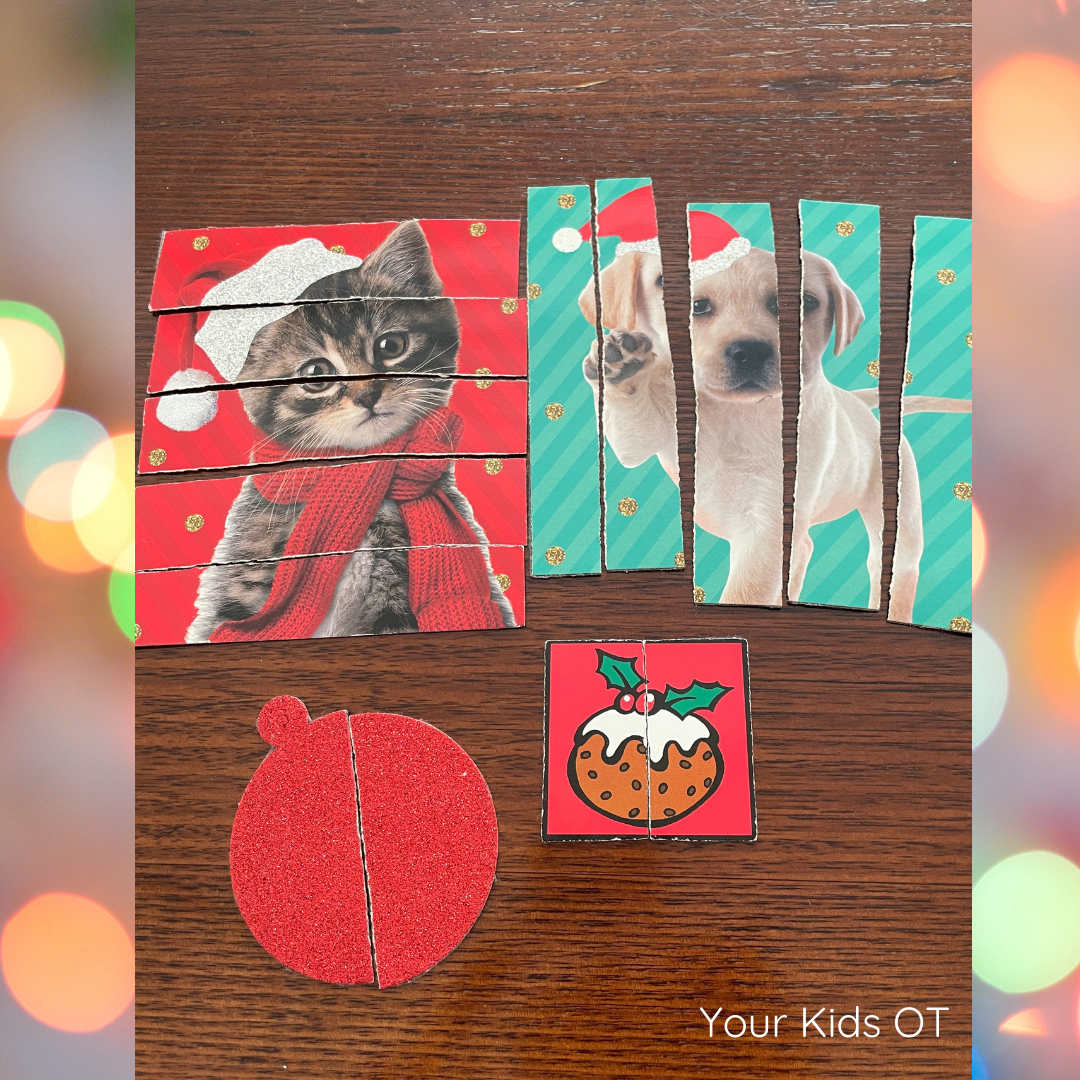
5. Christmas Tree Rings You will need: * Two Christmas craft trees (or alternatives could be empty plastic bottles, cardboard cones, etc). * Plastic Rings (mine are from Twister Rings or an alternative are swimming toy rings). * Balance Cushion Preparation - what to do: * Place trees within arms reach of balance cushion. Activity - what to do: * Ask your child to stand on the balance cushion and sort rings by colour over the trees. Activity benefits: * Encourage bilateral coordination. * Encourage motor planing. * Encourage eye-hand coordination. * Encourage crossing the midline. * Encourage balance skills. 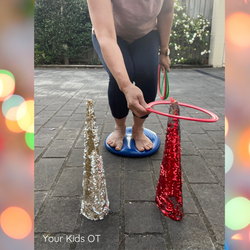
Watch these 5 activities in action with this video link.
Are you looking for more activities, worksheets and FREE printables for Christmas!
You will find a variety here at Your Kids OT. Click on the links below! * Christmas Fun Sheets * Christmas Activity Advent Calendar * Christmas Social and Emotional Competencies * Christmas Push Pin Tree * Christmas Tree Craft * Christmas Story Writing Prompts * 2020 Holiday Activity Pack * Christmas Tree Printable Pack * 2021 Christmas Free Printables So many activities to keep your children busy this holiday season! Let me know your favourites! ​ 
Cindy is a registered occupational therapist practising in Sydney, Australia. She has two growing children who are a constant source of inspiration and learning. Cindy loves working creatively to help children to reach their potential, finding opportunities in everyday living and making learning fun. She is also addicted to making printables (even when they take a long time to complete). Cindy is the author of the Occupational Therapy blog Your Kids OT. Read more articles from Your Kids OT at https://www.yourkidsot.com/blog
Cindy is a contributing author of the Functional Skills for Kids Therapy Team. They have together published THE HANDWRITING BOOK, THE SCISSORS SKILLS BOOK and THE TOILETING BOOK. ​The information on this site is general in nature. The activities are safe for most children, however, you should consult an Occupational Therapist or health professional to address specific movement, sensory or other medical conditions. Affiliate links are used throughout this website to promote recommended products. Your Kids OT receives a small commission if any purchases are made through these links. Please see my disclosure policy for more details. ​​​ Amazon Store: https://www.amazon.com/shop/yourkidsot YKOT shop: https://www.yourkidsot.com/store/c1/Featured_Products.html Teachers Pay Teachers: https://www.teacherspayteachers.com/Store/Your-Kids-Ot You Tube Channel: https://www.youtube.com/channel/UCZUz_5nYEOCkj32DiOCQo4Q/featured Facebook: https://www.facebook.com/yourkidsot Instagram: https://www.instagram.com/yourkidsot/ Pinterest: https://www.pinterest.com.au/yourkidsot/ ​ 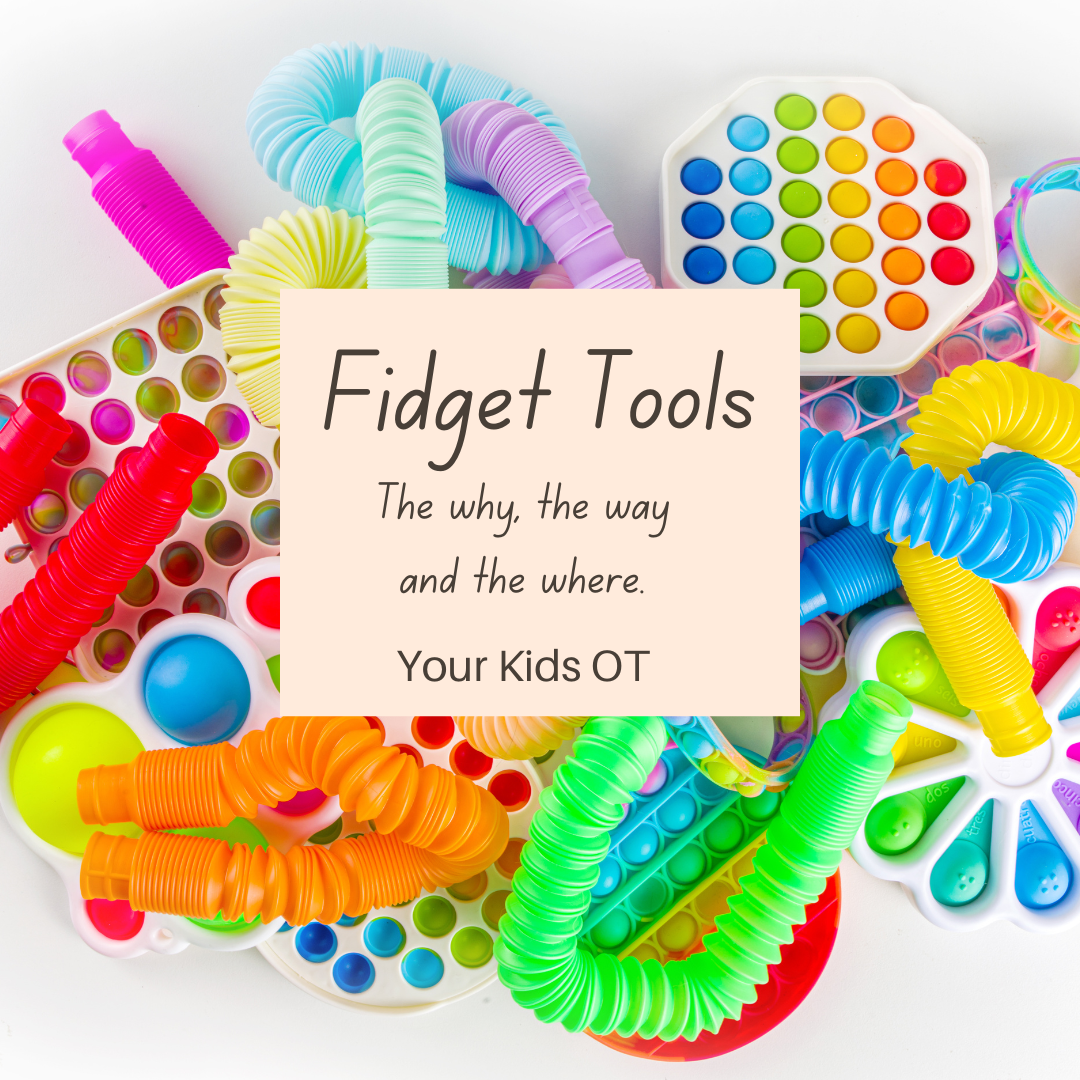 Fidget tool or toy? I used to be the first to ask this question but I have to confess that my thinking around "fidget tools and toys" has changed! It used to irk me so much when mainstream "fidget" toys became available and were "played" with by every child in a school as the lastest trend. You know the ones... fidget spinners, fidget cubes, pop it toys... every child needed to have one and "fidget" all the time. No! Internal and external crying out... not because fidgets have become mainstream (that is actually wonderful) but didn't people realise that fidgets are supposed to be tools for concentration. Discreet? Quiet? Unseen? Kept in a pocket? Not distract from other people or from the task at hand? I was recently asked by a friend's daughter for some background information about fidget toys and it was only then that I realised that my thinking around fidgets has evolved. Traditionally fidget tools have been used to help children with concentration in the classroom. A fidget was a way for tactile seekers to receive some input whilst still concentrating in class. They were manipulated by a child's hands and were those things I described earlier (discreet, quiet, unseen kept in a pocket or lap, not distracting). You may have seen lots of "fidget rules" posters that describe this use of fidgets in the classroom. 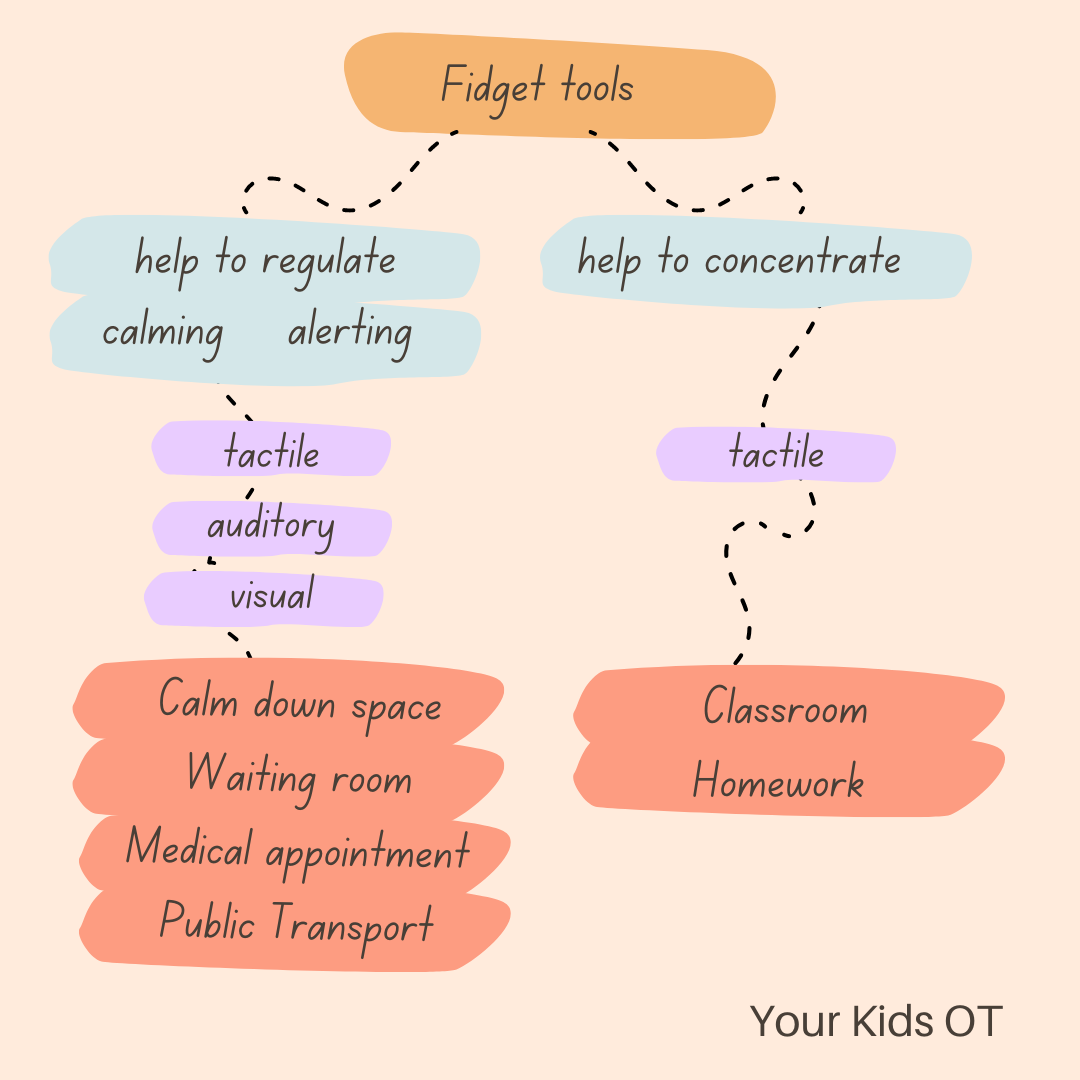 However, as you can see from the image above... I think there is value in those items that I would have previously classed as "toys". Instead of being used for concentrating on tasks (such as classroom and homework tasks), these fidget tools may be used to help with regulation. These fidget tools may help a child to become more alert or to help them with calming down. This is the place where fidgets may not only provide tactile sensory input but may also provide auditory and visual input. These fidgets may CONSUME the child and they may NOT be able to concentrate on other things. The fidget tools may actually provide a distraction from other things going on around them. Children may use these type of fidget tools in a calm down space. whilst in a waiting room, whilst on public transport or whilst attending a medical appointment. Can you think of other places your child might use these fidget tools? What if the fidget tool is not enough? A fidget tool is rarely enough. The caution with fidget tools (rather than toys) is that they should be used as part of a bigger picture in addressing a child's needs (whether that be concentration or regulation). Perhaps the child needs movement or deep pressure at other times of the day? Perhaps the child needs an awareness of routines and expectations? Perhaps the child needs a timer to help with transitions? Perhaps the child needs help with anxiety? Perhaps the child needs co-regulation with a trusted adult? Perhaps the child needs oral input with something to chew? Perhaps the child needs deep breathing or mindfulness activities? And the list could go on... Children who are not using fidget tools for concentration and regulation ... are really "playing". They become fidget TOYS. There is nothing wrong with "playing"! If you have followed me for any length of time, you will know that I highly value play. Fidget tools are not "fix alls". Fidget tools can help with concentration and regulation. Fidget tools can be used as part of a holistic approach to intervention. What is your mindset on fidget tools and toys? Have I challenged your thinking? Do you agree?   Cindy is a registered occupational therapist practising in Sydney, Australia. She has two growing children who are a constant source of inspiration and learning. Cindy loves working creatively to help children to reach their potential, finding opportunities in everyday living and making learning fun. She is also addicted to making printables (even when they take a long time to complete). Cindy is the author of the Occupational Therapy blog Your Kids OT. Read more articles from Your Kids OT at https://www.yourkidsot.com/blog
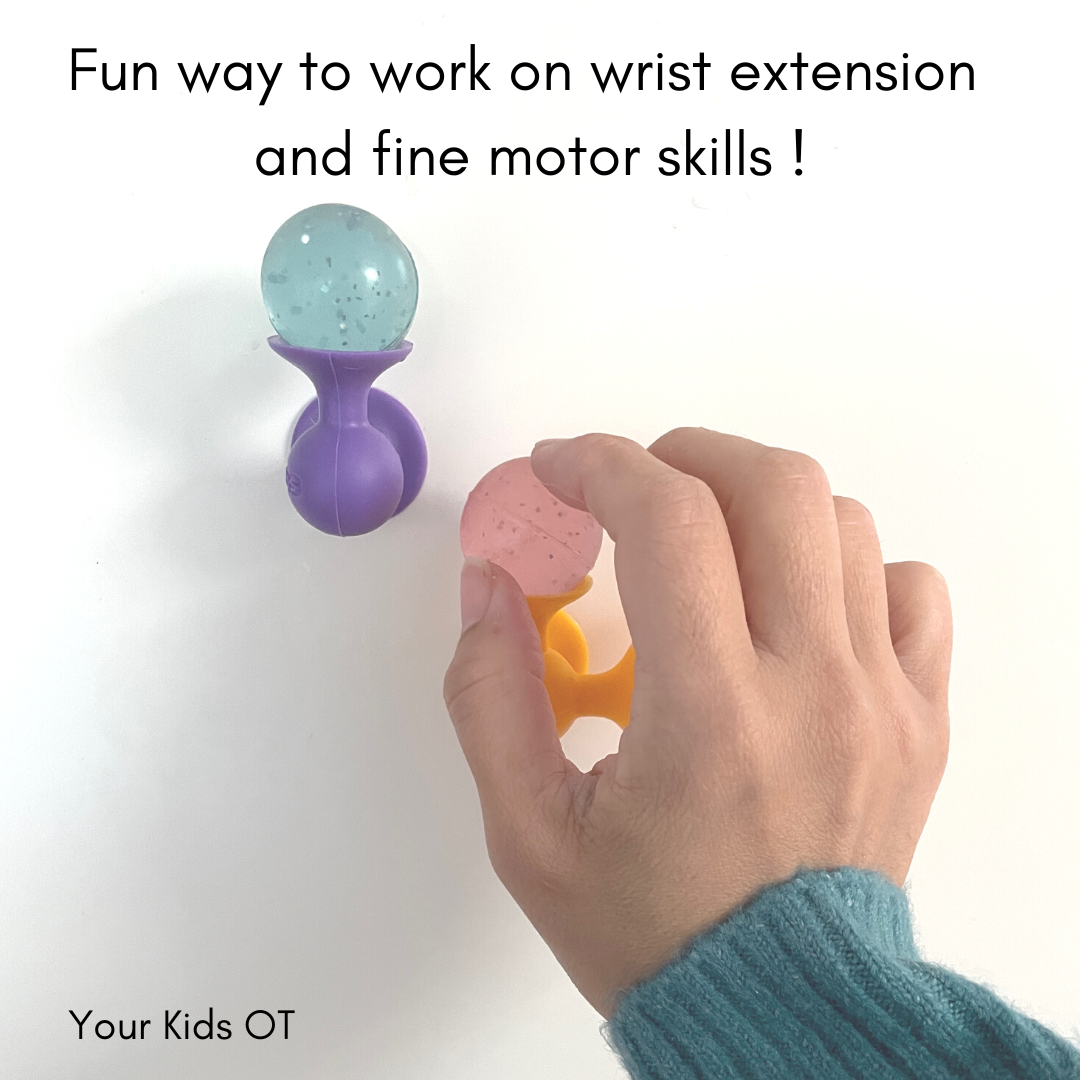
Cindy is a contributing author of the Functional Skills for Kids Therapy Team. They have together published THE HANDWRITING BOOK, THE SCISSORS SKILLS BOOK and THE TOILETING BOOK. The information on this site is general in nature. The activities are safe for most children, however, you should consult an Occupational Therapist or health professional to address specific movement, sensory or other medical conditions. Affiliate links are used throughout this website to promote recommended products. Your Kids OT receives a small commission if any purchases are made through these links. Please see my disclosure policy for more details. Amazon Store: https://www.amazon.com/shop/yourkidsot YKOT shop: https://www.yourkidsot.com/store/c1/Featured_Products.html Teachers Pay Teachers: https://www.teacherspayteachers.com/Store/Your-Kids-Ot You Tube Channel: https://www.youtube.com/channel/UCZUz_5nYEOCkj32DiOCQo4Q/featured Facebook: https://www.facebook.com/yourkidsot Instagram: https://www.instagram.com/yourkidsot/ Pinterest: https://www.pinterest.com.au/yourkidsot/ Fun way to work on wrist extension and fine motor skills (fundamental skills for pencil control)!13/9/2022
A hooked wrist?
Wrist off the table? A neutral hand, wrist and forearm? In order for fingers to be able to manipulate writing tools in a dynamic way, a child needs to have developed shoulder stability, forearm stability and... wrist extension. Wrist extension can sometimes be overlooked. Some people are super focused on pencil grasp and how the fingers are holding the pencil, that the wrist is not considered. Without a stable wrist and forearm, the fingers will have difficulty moving the pencil. What tends to happen is that the fingers get "locked into position" for stability and movement of the pencil comes from the wrist, elbow or shoulder. Some people are super "unfocused" ... ok, that's not a word... some people are not considering pencil grasp at all. They have swung the other way to say that pencil grasp is not important. If you have read any of my previous blog posts, you will know that I'm all about function but other considerations need to be taken into account too... * Is your child just learning how to write ? Are they developmentally ready to write? * Is your child experiencing pain? * Is your child experiencing fatigue? * Is your child producing letter reversals or confusion with writing? * Is your child complaining about writing and having difficulty keeping up with the class? * Is your child slow? * Is your child's pencil pressure too hard or too light? There are many reasons to consider pencil grasp. There are many reasons to look at the biomechanics of a child's writing and where pencil control is coming from. OK, so back to a fun way to work on wrist extension and fine motor skills! OTs love to use vertical surface to support wrist stability and extension. Here is an activity that is quick and easy to set up, with so many benefits! What you need:
What to do:
** WATCH THIS IN ACTION ---> Your Kids OT IG 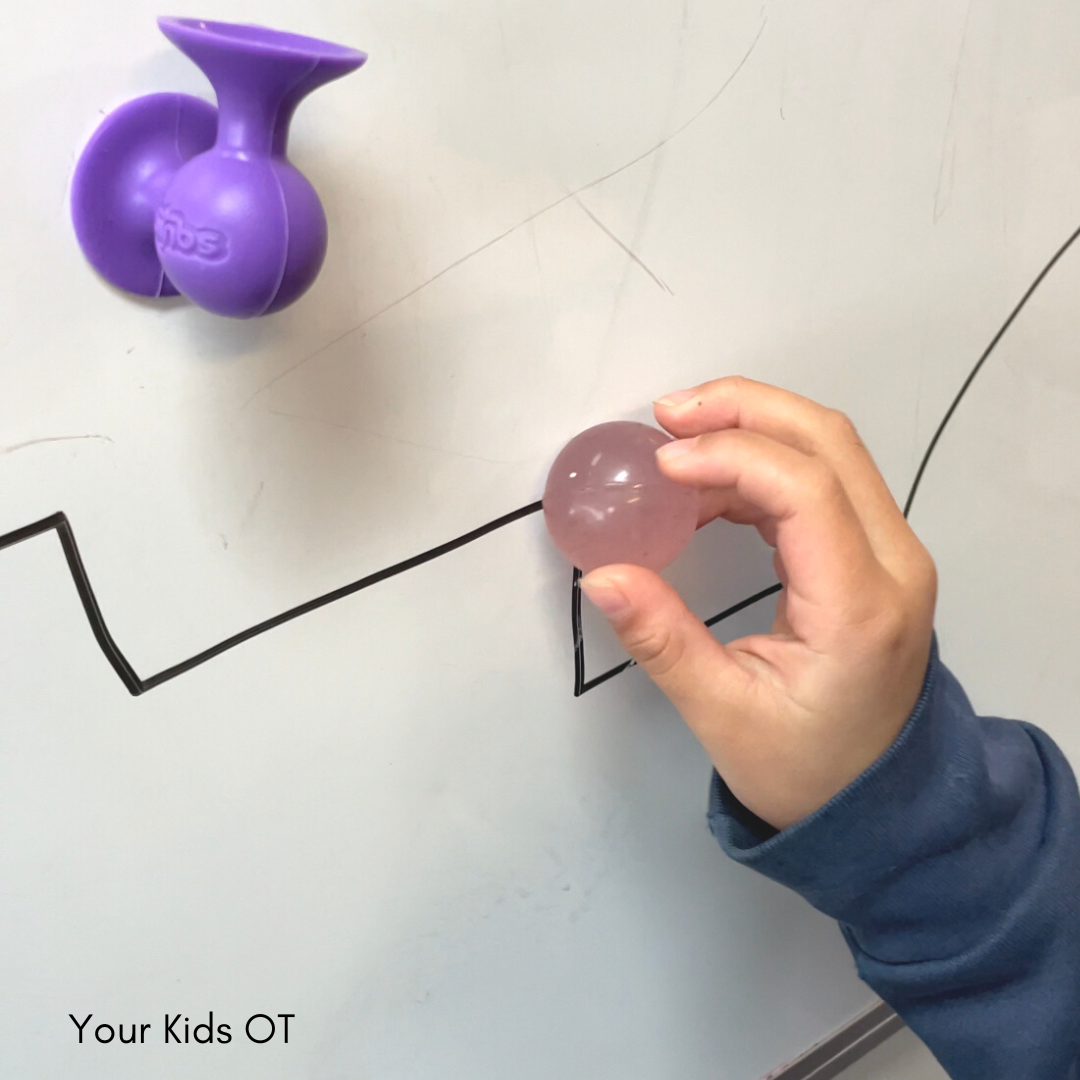
Variation:
In addition to wrist extension and fine motor skills... this variation will also work on crossing the midline, motor planning as well as drawing. ** WATCH THIS IN ACTION ---> Your Kids OT IG​​
For more information on handwriting and pencil grasp, check out the articles HERE. For more information on fine motor skills, check out the articles HERE.
Give this activity a try! What are some of your favourite vertical surface activities? What other ways can you help to develop wrist stability and extension? ​ 
Cindy is a registered occupational therapist practising in Sydney, Australia. She has two growing children who are a constant source of inspiration and learning. Cindy loves working creatively to help children to reach their potential, finding opportunities in everyday living and making learning fun. She is also addicted to making printables (even when they take a long time to complete). Cindy is the author of the Occupational Therapy blog Your Kids OT. Read more articles from Your Kids OT at https://www.yourkidsot.com/blog
Cindy is a contributing author of the Functional Skills for Kids Therapy Team. They have together published THE HANDWRITING BOOK, THE SCISSORS SKILLS BOOK and THE TOILETING BOOK. ​The information on this site is general in nature. The activities are safe for most children, however, you should consult an Occupational Therapist or health professional to address specific movement, sensory or other medical conditions. Affiliate links are used throughout this website to promote recommended products. Your Kids OT receives a small commission if any purchases are made through these links. Please see my disclosure policy for more details. ​​​ Amazon Store: https://www.amazon.com/shop/yourkidsot YKOT shop: https://www.yourkidsot.com/store/c1/Featured_Products.html Teachers Pay Teachers: https://www.teacherspayteachers.com/Store/Your-Kids-Ot You Tube Channel: https://www.youtube.com/channel/UCZUz_5nYEOCkj32DiOCQo4Q/featured Facebook: https://www.facebook.com/yourkidsot Instagram: https://www.instagram.com/yourkidsot/ Pinterest: https://www.pinterest.com.au/yourkidsot/ 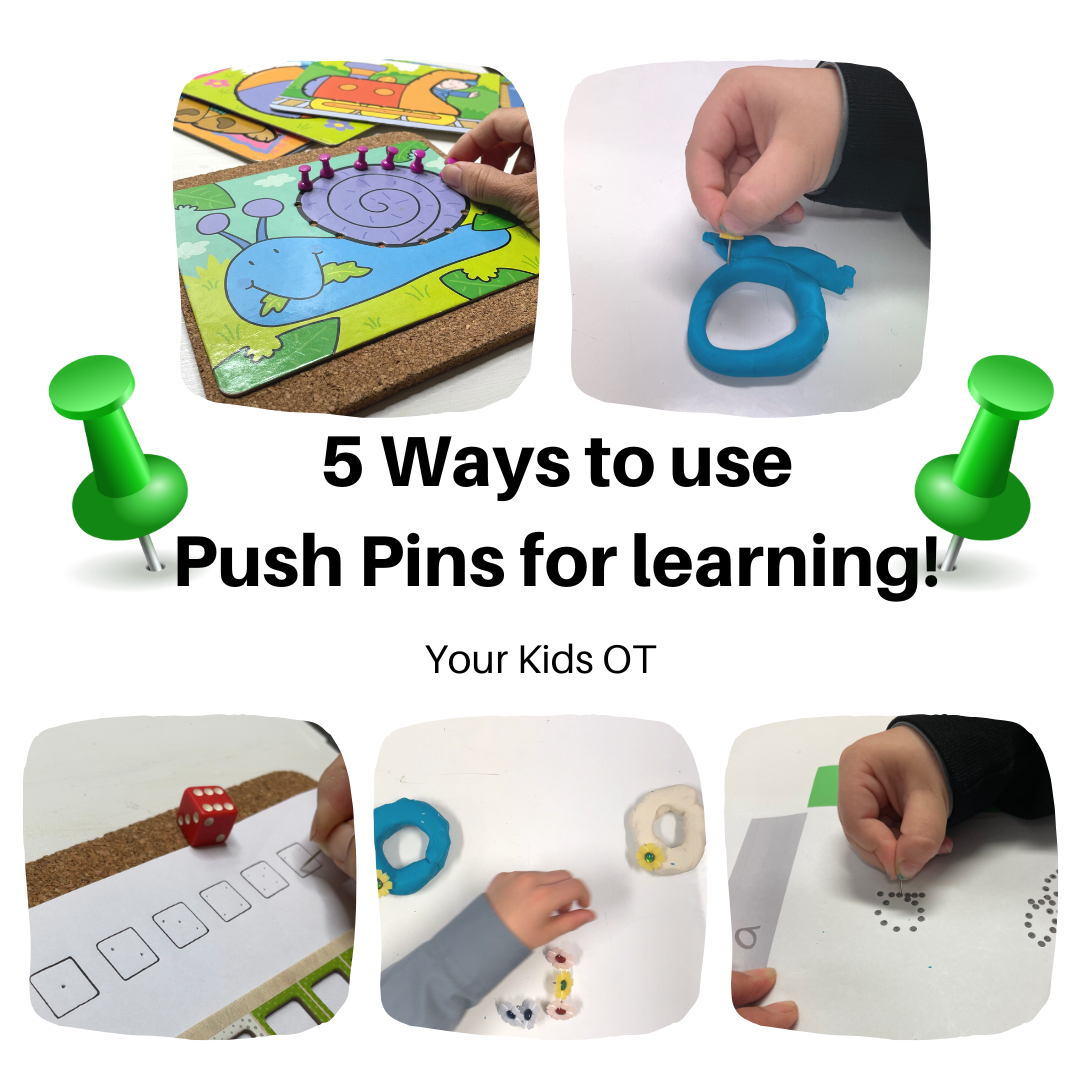 Poke poke poke. Kids love making holes! Here is a legitimate way that they can make holes and learn at the same time.... by using "push pins" (or drawing pins, depending on where you are in the world). If you have been following me here at Your Kids OT for a while, you will know that I love incorporating push pin activities into therapy session for SO many reasons. From the development of fine motor skillls, hand strength, building eye/ hand coordination to providing sensory feedback to the hand whilst learning. The fingers are provided with "'heavy work" and lots of proprioceptive information is fed back to the fingers and hands during these activities. Children are so engaged with push pin activities and they often "work hard" even when they are beginning to fatigue. Read more about the reasons for using push pins HERE. All push pin activities should be supervised closely. These activities are not suitable for those who are mouthing objects and unable to follow instructions. Recommended age for use of push pins is 4 years and older. Here are 5 ways to incorporate push pins to learning! 1. Push Pins and Lacing Cards Use a cork mat and lay a "lacing/threading" card on top. These cards already have holes in them, normally use to weave laces in and out for preschool age children. Preschool age children enjoy the novelty of placing push pins into the holes of these cards. If you don't have lacing cards, use cardboard and a hole punch to create your own pictures.  2. Push Pins and Playdough Crossing the Midline Create two playdough rings. Use push pins (I have flower ones) that are planted into playdough rings when I call out left or right. This encourages children to work on crossing the midline, left and right discrimination. These skills are important especially for those who those who shuffle along their chair when they write or make adjustments to avoid crossing the midline. Read more about crossing the midline and bilateral coordination HERE.  3. Push Pins and Playdough Letter Formation Create letters using playdough. Use a push pin to make holes in the playdough letter. Make sure you start in the correct position and move in the correct direction for writing the letter. You can work on lowercase letters, capital letters, shapes, numbers, a child's name or even words.  4. Push Pins with Paper: Pictures and Letters This activity moves a child from object-based learning to paper activities. It links physical hands-on learning with what is going on in printed form. You will need the printables from the YKOT to either create a picture or letter. We use a cork mat, laying down coloured paper and the chosen printable page. We can focus on one letter and picture; using this as a writing prompt to write a sentence. Children love to hold up their final picture to the light and see it coming through the holes. For younger children, I use the picture printable to create a drawing. For some children, I use the face emotion pictures and link this with social emotional learning. Find the printables ... * Alphabet Dot Pictures * Push Pin Poke Drawing Templates These printables are also available at the YKOT Teachers Pay Teachers Store ($US).
5. Push Pin, Die and Numbers! Numbers, maths and a "die" go hand in hand. We add a push pin to make this a very hands on learning experience. I use an old game insert with square hole to draw small square shapes. You could also just draw some squares. We can work on:- * number identification - roll the die and make holes to match * writing numbers - roll the die, make holes and write the number * before and after numbers - roll the die, make holes, then write the number before and the number after * addition and subraction - roll the die to find numbers to add or subtract, make holes to work out the answer 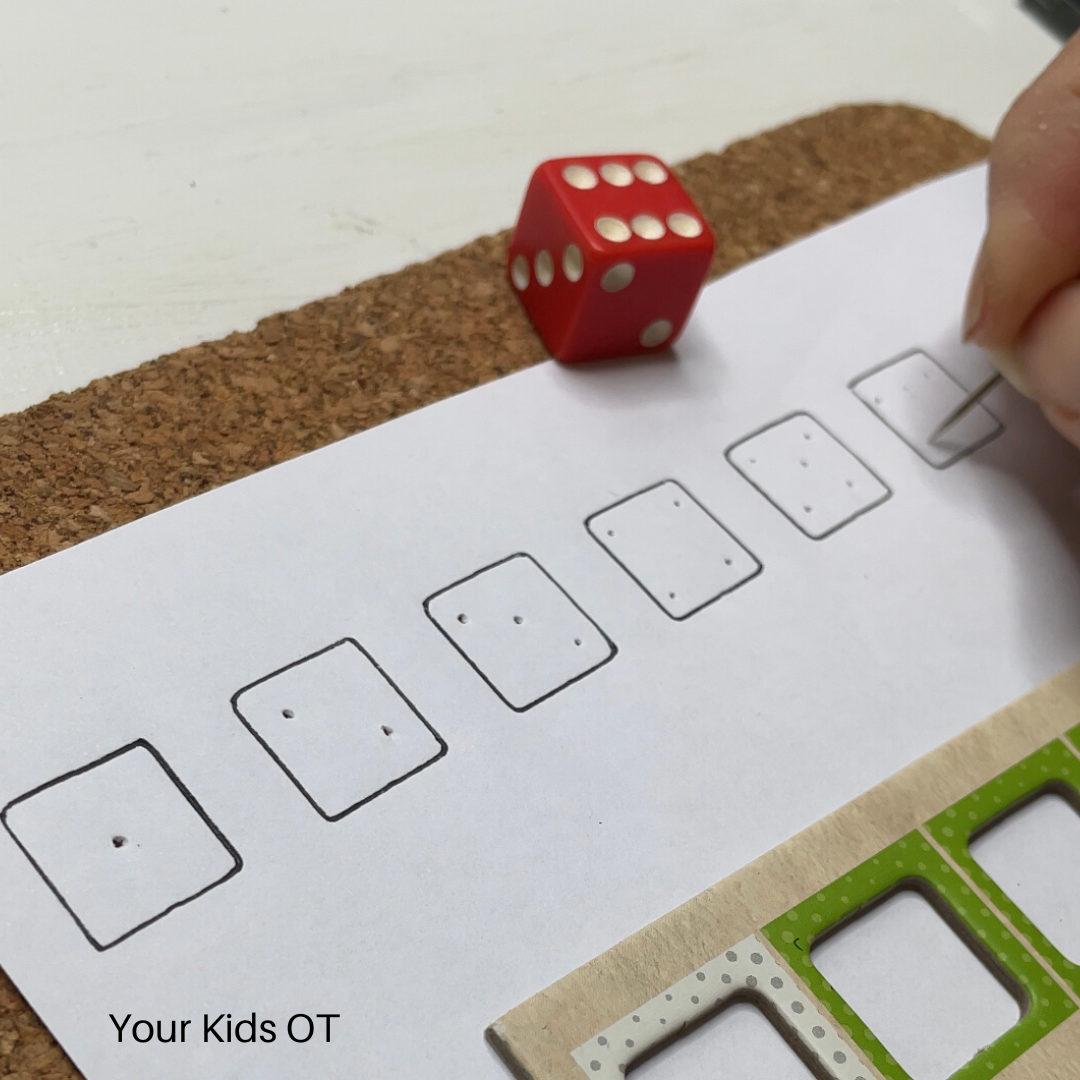 Watch these Push Pin Activities on the You-Tube Video. What is your favourite "push pin" activity and which one will you try out?   Cindy is a registered occupational therapist practising in Sydney, Australia. She has two growing children who are a constant source of inspiration and learning. Cindy loves working creatively to help children to reach their potential, finding opportunities in everyday living and making learning fun. She is also addicted to making printables (even when they take a long time to complete). Cindy is the author of the Occupational Therapy blog Your Kids OT. Read more articles from Your Kids OT at https://www.yourkidsot.com/blog
Cindy is a contributing author of the Functional Skills for Kids Therapy Team. They have together published THE HANDWRITING BOOK, THE SCISSORS SKILLS BOOK and THE TOILETING BOOK. The information on this site is general in nature. The activities are safe for most children, however, you should consult an Occupational Therapist or health professional to address specific movement, sensory or other medical conditions. Affiliate links are used throughout this website to promote recommended products. Your Kids OT receives a small commission if any purchases are made through these links. Please see my disclosure policy for more details. Amazon Store: https://www.amazon.com/shop/yourkidsot YKOT shop: https://www.yourkidsot.com/store/c1/Featured_Products.html Teachers Pay Teachers: https://www.teacherspayteachers.com/Store/Your-Kids-Ot You Tube Channel: https://www.youtube.com/channel/UCZUz_5nYEOCkj32DiOCQo4Q/featured Facebook: https://www.facebook.com/yourkidsot Instagram: https://www.instagram.com/yourkidsot/ Pinterest: https://www.pinterest.com.au/yourkidsot/  TheimportanceoftheSIZEoflettersandspacingcannotbeundervaluedwhenitcomestohandwritinglegibility. Did you get that? The importance of the size of letters and spacing can not be undervalued when it comes to handwriting legibility. The size of letters, their alignment to the writing line and having adequate spaces between words (and letters) affects how we read written information. Ideally we want all writing (letters and spacing) to be uniform but many can not achieve this (even adults)! If just one aspect of neat writing is achieved, then it does help the reader to deciper the written work. Before I give you some tips, try an experiment... Get out some ruled lined paper. Draw two horizontal lines between the printed lines, dividing the space into thirds. Make sure the lines are parallel with the spacing staying consistent. Don't turn the page and don't turn your arm. Did you find this easy or difficulty? Now ask your child to do the same. Can they draw two horizontal lines with consistent spacing? I would say that if your child has handwriting difficulties then they will want to move the page or their arm. They will have difficulty with consistent spacing and their lines will not run parrallel. This is probably (and I'm making broad generalisations) due to difficulty with visual spatial awareness, visual motor control and pencil control. There may be underlying difficulties in other areas too. Ok, so what can we do about it? 1. Sizing and spacing with blocks. I use 1cm craft blocks to represent the size of a "small letter". We use two stacked blocks above the line for a "capital letter" or "tall letter". Two blocks (one above and one below) are used to represent a "tail letter". Single words are practiced with the blocks and then sentences are made. We work on a block space between each word. We work on making short sentences with the blocks and then writing the sentence (either on a whiteboard or chalkboard). Some children may require an adult to write the sentence as a model for them to make with blocks. This is a visually engaging way to help children to develop visual spatial awareness whilst working on size and spacing. 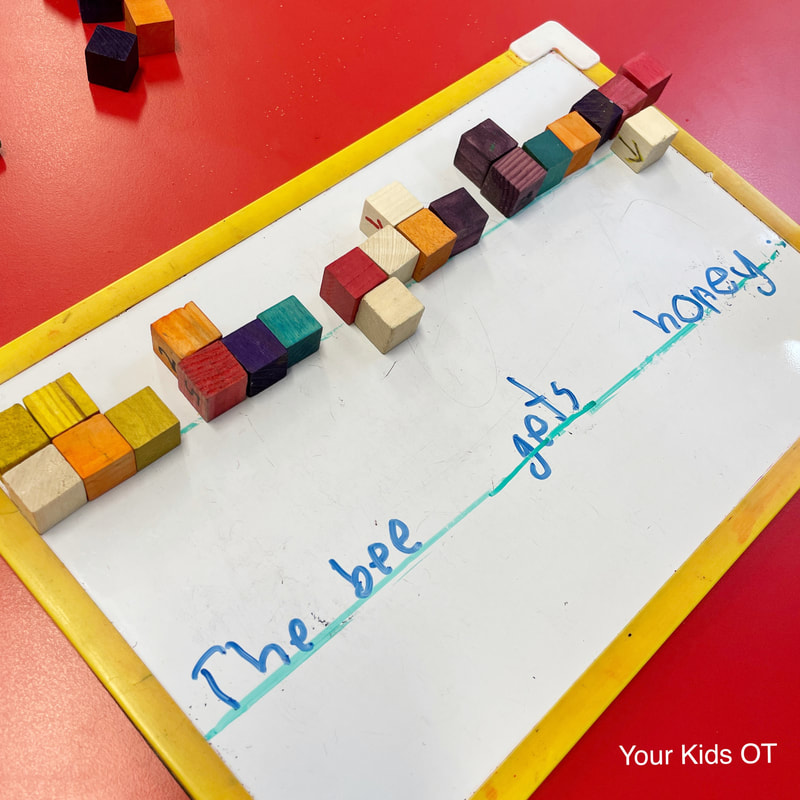 2. Meatballs and Spaghetti. This idea has been around for a long time and encourages children to place "meatball" size spaces between words and "spaghetti" size spaces between letters. You can make this more visually obvious by using something like wikki stix or playdough to make the meatball and spaghetti. Playdough and wikki stix also afford the flexibility of making the writing line and letters of the alphabet. You can work on the size of letters and their alignment to that line. 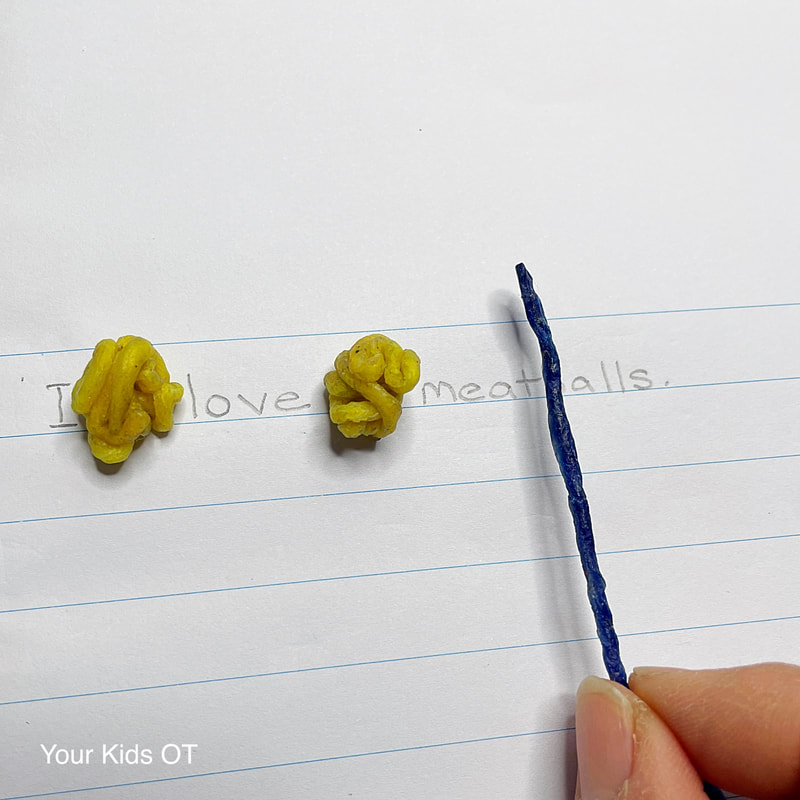 3. White writing implements! Don't throw away the unused white crayon or white pencil. Use these to help delineate spaces between words. Have your child switch from their ordinary pencil to the white one to draw a small dot between words. For some children the action of putting down one pencil and picking up another (in any colour) will help with the motor plan to leave a gap between words. I prefer a white pencil for obvious reasons ... that it can't be obviously when we look at the overall sentence. The child is introduced to "white space" between words. If this is not enough to help your child with spacing, you may use a coloured pencil between the ordinary pencil to make a more obvious dot. 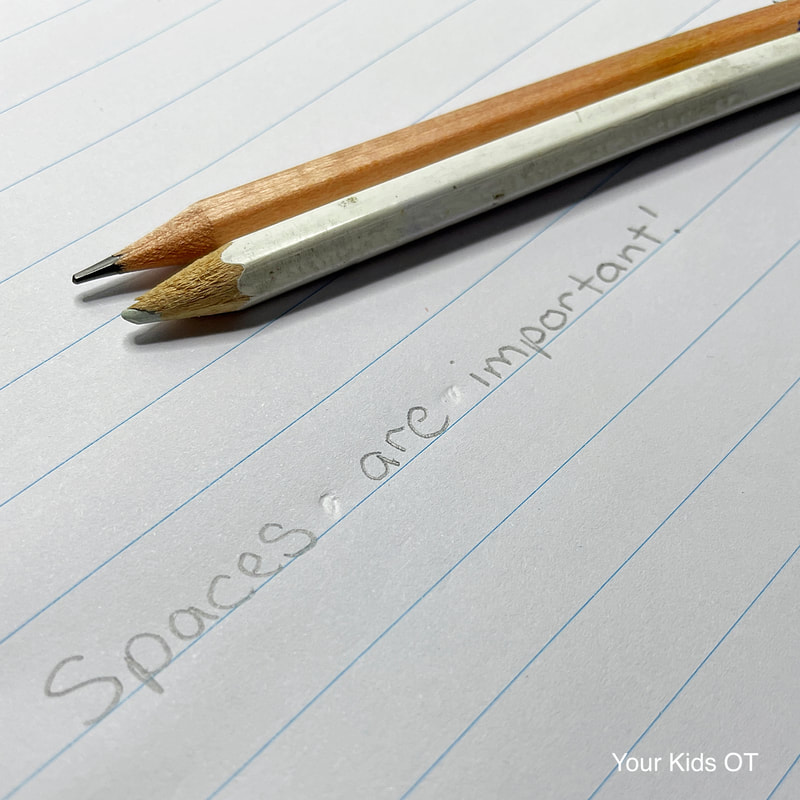 4. Grid paper. Grid paper (or boxed paper) is often used by children in mathematics or for Chinese students in writing characters. There is a reason for this... it helps visually with spacing and size! You can practice visual motor and pencil control skills with grid paper. Have your child copy patterns to see if they can continue with the same size and spacing that you have drawn. You can use the grid paper to work on letter sizes and word spacing too. Each square could represent the height of a small letter with two letters being the size of a tall letter. Alternatively, a square could be the size of tall letter and the child needs to write in half the square to create a small letter. Using the grid paper is adapable to your child's needs. In the example below, this child has difficulty with visual motor and pencil control skills. We work on these things, however the achievement for this child is having a letter in each box providing a small space between each letter and then a large space (a box) between each word. The size of the grid paper you choose will depend on the age and ability of your child. 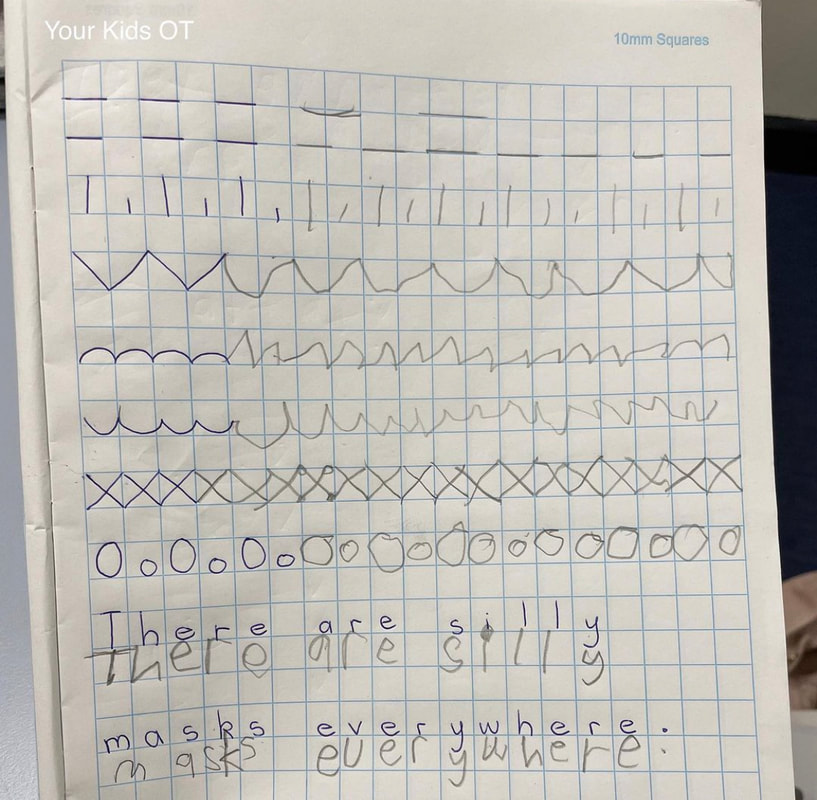 5. Modified (or adapative) paper. There are a number of variations of modified paper on the market. From my own "Earth paper lines" to these examples here, here and here. For some children, changing the paper up is the quickest way to helping them see how letters should be sized and spaced for legibility. They can use the paper (or try a few options) to develop good writing habits. The paper is then "weaned off" so that the child can make links to ordindary paper and carry over their new found legibility. Some children will find the "carry over" and "weaning off" difficult and they benefit from a longer term use of modified paper. For some children the modified or even grid paper doesn't work! Why? Modified and grid paper requires a certain amount of visual spatial awareness and pencil control already to use it. For these children, the modified paper just highlights how difficult writing is to start with and they may need more help with noticing lines and distinguishing shapes. For example, a ruler can provide a physical boundary for the writing line so students "bump the line" (read more here). 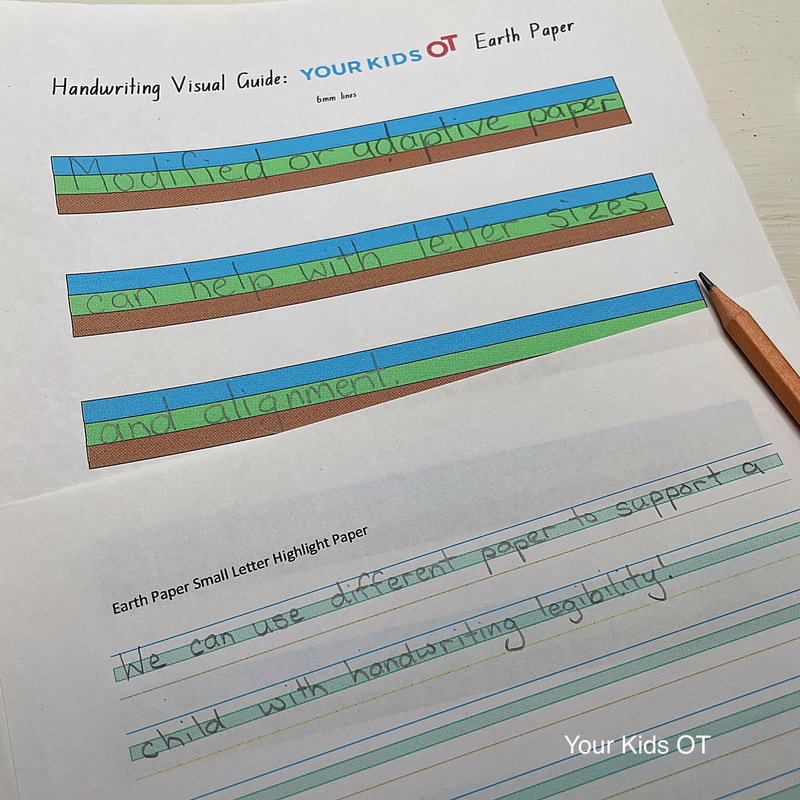 So when is a good time to work on letter sizes and spacing?? Generally when children are introduced to writing letters, formation is of key importance. The starting position, the direction and the shape of letters (and numbers). We don't worry too much about sizing and spacing as we want children to be successful and gain pencil control. For Kindergarten children (approx age 5- 6 years old) learning to write may find it easier to use their whole arm to control the pencil and may be only beginning to develop dynamic finger movements on the pencil (ie. a dynamic tripod grasp). This is why they find it easier to write large letters and words. As children move onto writing sentences and a writing line is introduced; spacing and sizing become more important. Older children (ie. 8 years and older) referred for occupational therapy with poor handwriting legibility benefit greatly from working on sizing and spacing. This is when legibility is prioritised over letter formation and we want more output (writing) on the page. Need more tips on handwriting? Make sure you read past articles HERE. You can also find more information in "THE HANDWRITING BOOK" where I am a contributing author. This e-book may now be purchased from the Your Kids OT SHOP. Which suggestion will you be trying with your child to work on sizing and spacing in handwriting?   Cindy is a registered occupational therapist practising in Sydney, Australia. She has two growing children who are a constant source of inspiration and learning. Cindy loves working creatively to help children to reach their potential, finding opportunities in everyday living and making learning fun. She is also addicted to making printables (even when they take a long time to complete). Cindy is the author of the Occupational Therapy blog Your Kids OT. Read more articles from Your Kids OT at https://www.yourkidsot.com/blog
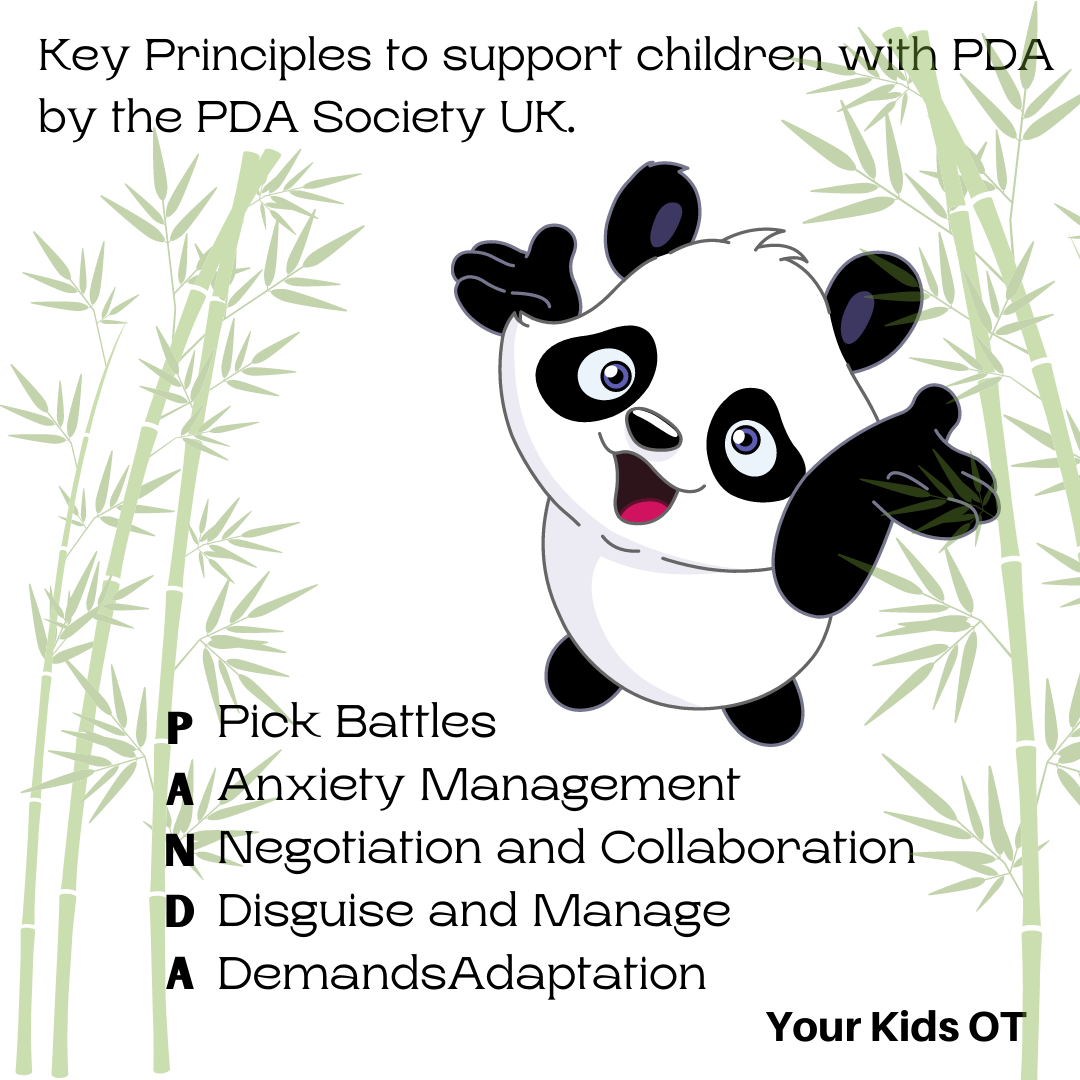
Cindy is a contributing author of the Functional Skills for Kids Therapy Team. They have together published THE HANDWRITING BOOK, THE SCISSORS SKILLS BOOK and THE TOILETING BOOK. The information on this site is general in nature. The activities are safe for most children, however, you should consult an Occupational Therapist or health professional to address specific movement, sensory or other medical conditions. Affiliate links are used throughout this website to promote recommended products. Your Kids OT receives a small commission if any purchases are made through these links. Please see my disclosure policy for more details. Amazon Store: https://www.amazon.com/shop/yourkidsot YKOT shop: https://www.yourkidsot.com/store/c1/Featured_Products.html Teachers Pay Teachers: https://www.teacherspayteachers.com/Store/Your-Kids-Ot You Tube Channel: https://www.youtube.com/channel/UCZUz_5nYEOCkj32DiOCQo4Q/featured Facebook: https://www.facebook.com/yourkidsot Instagram: https://www.instagram.com/yourkidsot/ Pinterest: https://www.pinterest.com.au/yourkidsot/  No, I don’t want to. No, I can’t do it. No, I want to but I don’t know how. No, not today. No, I have never done this before. No, not in front of you. No, I wasn’t expecting to do this. No, I think it is too hard. No, I don’t have enough time. No, you have already asked me. No, I’ve done it before so why do I have to do it again? What does “no” mean? Children who are “demand avoidant” are not “being naughty”. They are not seeking a power struggle with you as the adult in their lives. They are impacted by anxiety, fear and loss of control where a task (which appears to be within their scope to complete) becomes unachievable. Simple tasks and even tasks they have completed previously are too “demanding”. Pathological Demand Avoidance is described as a profile of Autism. A low threshold of tolerance to a variety of “demands” results in the child reacting with a fight, flight or freeze response. Anxiety and a need to feel in control underpin a child’s avoidant behavior. Each child who demonstrates avoidant behavior may do this in different ways. It could include shouting, laughing, crying, screaming, hiding, not talking, running away, throwing things, repetitive actions and more. Different children will present in different ways. One individual child may also show a range of behaviour that changes depending on the demand or who the child is with at the time. 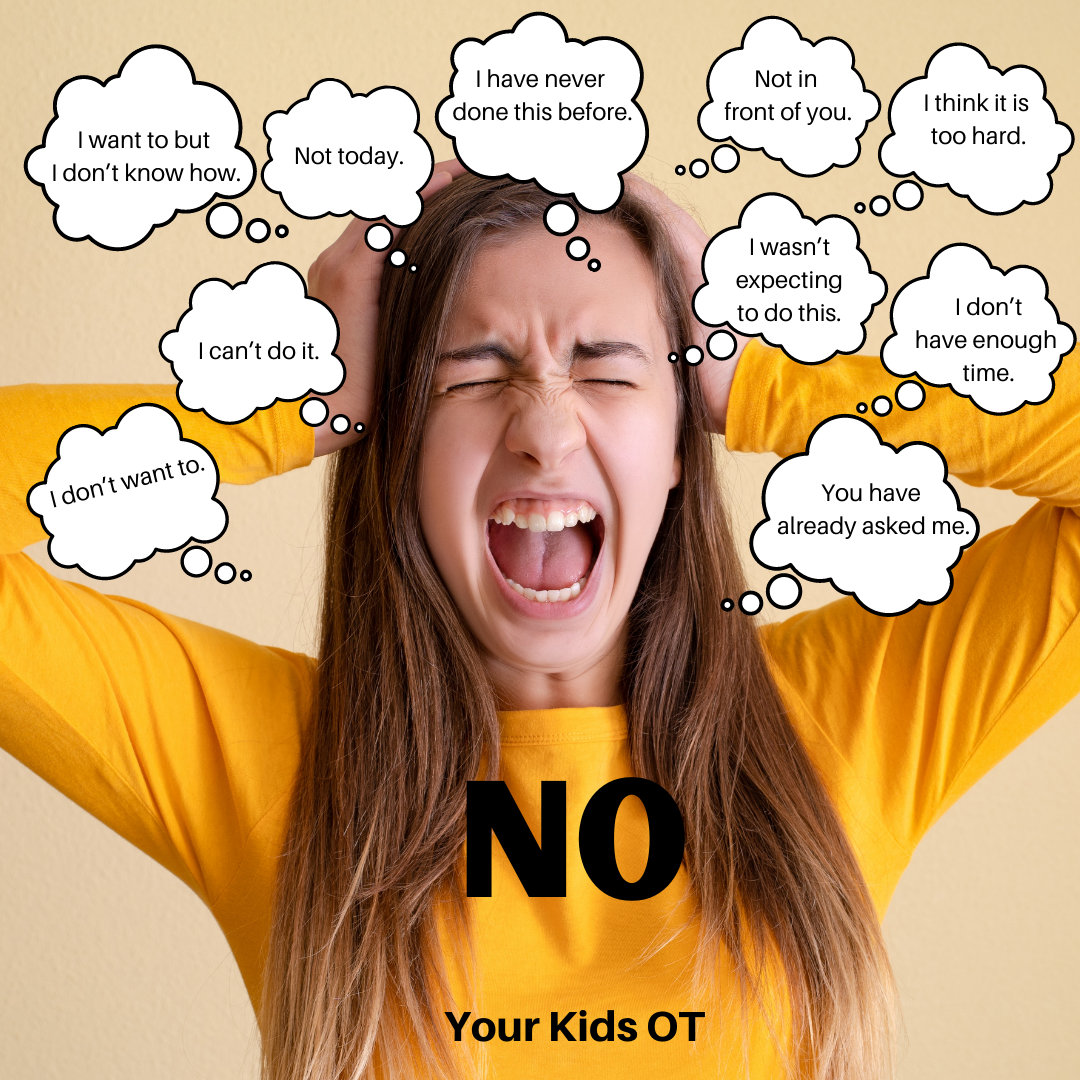 The PDA society lists the following key principles for parents, teachers and therapist in helping a child with PDA; built on an engaged relationship between the child and adult. P: Pick Battles A: Anxiety Management N: Negotiation and Collaboration D: Disguise and Manage Demands A: Adaptation As an occupational therapist, finding the “just right challenge” is important for all children. For children with PDA, this can be particularly challenging. The importance of a therapeutic relationship should not be underestimated. Built on trust; rapport and respect need to be established before any “demands” can be expected. A therapeutic goal of “joint attention to a task” may be an essential foundation before further goals are established. Whilst every child is different, here are 5 examples of incorporating the PDA society principles.
In general; “heavy work” or opportunities for proprioception to joints, muscles and skin can help a child to regulate. This may include:
You can read more about sensory supports: 2. Include a puppet (or toy or pet). Puppets can help with communication. They can be used in a variety of ways that are engaging and fun for the child. Here are some examples for using a puppet:
3. Be flexible. There is nothing achieved with a power struggle between an adult and child. Having plan B is an important adaptation. Whilst some tasks should not be avoided for safety or long term health, many tasks can be forgone for something else or at least postponed. When a task really needs to be done, consider:
 4. Explore and engage with the child’s interest. Whilst there are often concerns of a child’s predominant interests becoming obsessions, exploring and engaging with the child’s interest may be an important step in “joint attention” and establishing rapport. Can the interest be used to try new activities? (eg. An interest in camping may lead to cutting paper “logs” to build a camp fire. An interest in planets may lead to drawing dotted lines for the space ship to visit each planet. An interest in video games may lead to creating a game to learn letters in a child’s name.) 5. Praise and rewards used unconventionally. Praise comes naturally when something is done well. We want to praise the child and their efforts. We want to reward behaviour that we want to see repeated. These can both (whilst seemingly positive) can cause a child to feel anxious with a perceived demand to repeat or improve performance of the activity (which may be your motivation and what you want). Complicated! This requires re-framing so …
Videos, books and social stories can be useful ways to help a child with PDA to de-personalise situations, learn from modelling and discuss how others approach a task or situation. Head over to Growing Hands on Kids where I have also written ANOTHER five strategies to support PDA - 5 Strategies to Support Pathological Demand Avoidance - Growing Hands-On Kids (growinghandsonkids.com) including creating a game with the task, do the task together, reduce indirect demands, ask without asking, using humor or novelty. Supporting a child with PDA takes time, creativity, patience and empathy. It is not easy and emotions may run high quickly. For further information on Pathological Demand Avoidance, refer to: * PDA Society, * Sally Cat’s PDA Page, * Pathological Demand Avoidance Australia & New Zealand, * Pathological Demand Avoidance Teaching Strategies (Podcast) Do you support a child with PDA? What has worked for you both?   Cindy is a registered occupational therapist practising in Sydney, Australia. She has two growing children who are a constant source of inspiration and learning. Cindy loves working creatively to help children to reach their potential, finding opportunities in everyday living and making learning fun. She is also addicted to making printables (even when they take a long time to complete). Cindy is the author of the Occupational Therapy blog Your Kids OT. Read more articles from Your Kids OT at https://www.yourkidsot.com/blog
Cindy is a contributing author of the Functional Skills for Kids Therapy Team. They have together published THE HANDWRITING BOOK, THE SCISSORS SKILLS BOOK and THE TOILETING BOOK. The information on this site is general in nature. The activities are safe for most children, however, you should consult an Occupational Therapist or health professional to address specific movement, sensory or other medical conditions. Affiliate links are used throughout this website to promote recommended products. Your Kids OT receives a small commission if any purchases are made through these links. Please see my disclosure policy for more details. Amazon Store: https://www.amazon.com/shop/yourkidsot YKOT shop: https://www.yourkidsot.com/store/c1/Featured_Products.html Teachers Pay Teachers: https://www.teacherspayteachers.com/Store/Your-Kids-Ot You Tube Channel: https://www.youtube.com/channel/UCZUz_5nYEOCkj32DiOCQo4Q/featured Facebook: https://www.facebook.com/yourkidsot Instagram: https://www.instagram.com/yourkidsot/ Pinterest: https://www.pinterest.com.au/yourkidsot/ 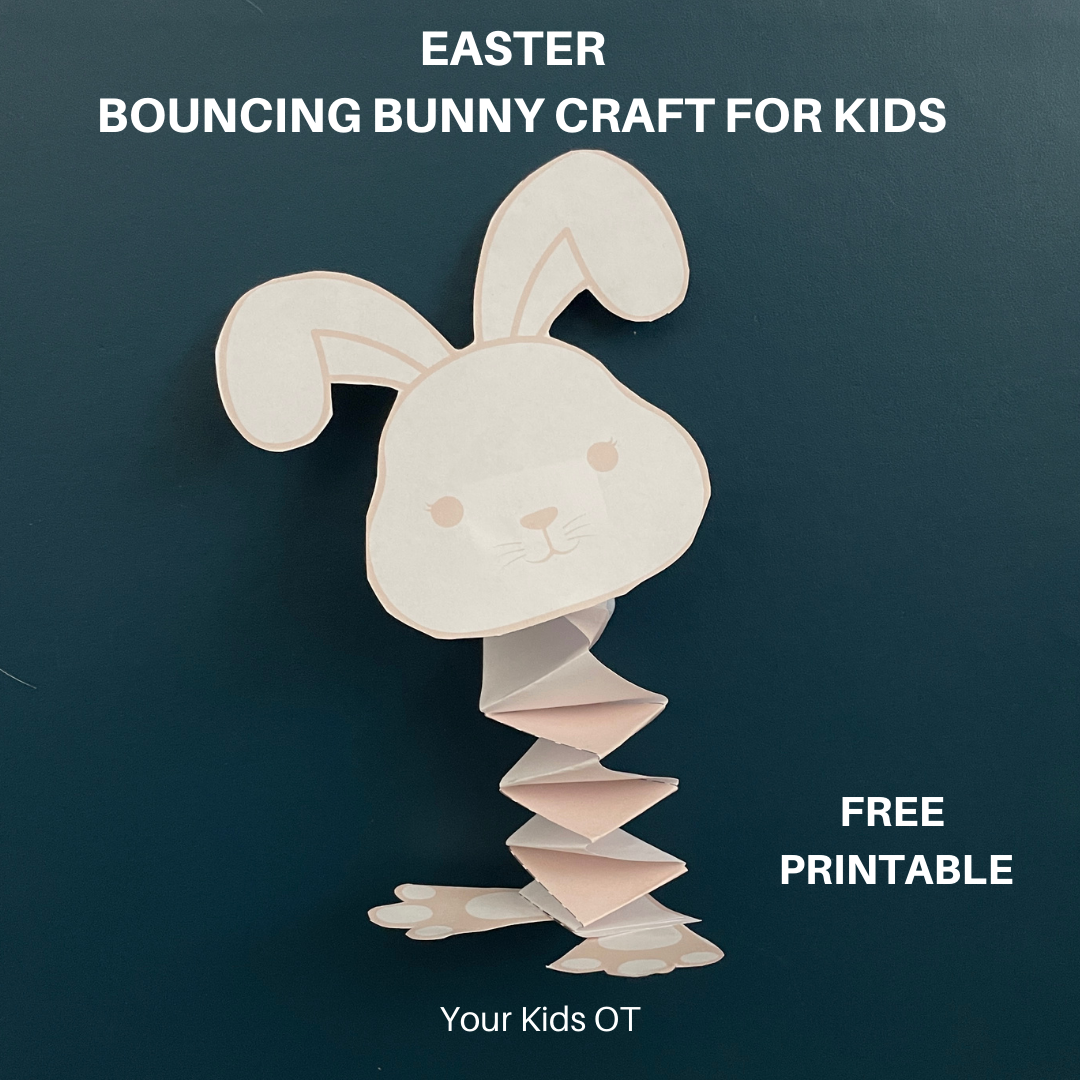 We are approaching Easter and the run to the school holidays here in Sydney is real! Just a few day left of the term. Create a cute bouncing bunny with a FREE template.
An Easter inspired activity to encourage scissor skills, bilateral coordination and motor planning. Watch me make the bouncing bunny ---> https://youtube.com/shorts/z5VTkHFAv3A?feature=share Get your FREE BOUNCING BUNNY PRINTABLE HERE! Also check out other EASTER inspired activities: * Q Tip Easter Craft * Easter Scissor Skills Eggs * Oral Motor Easter Egg Transfer * Easter Drawing for Scribblers * Easter Prewriting Lines and Shapes 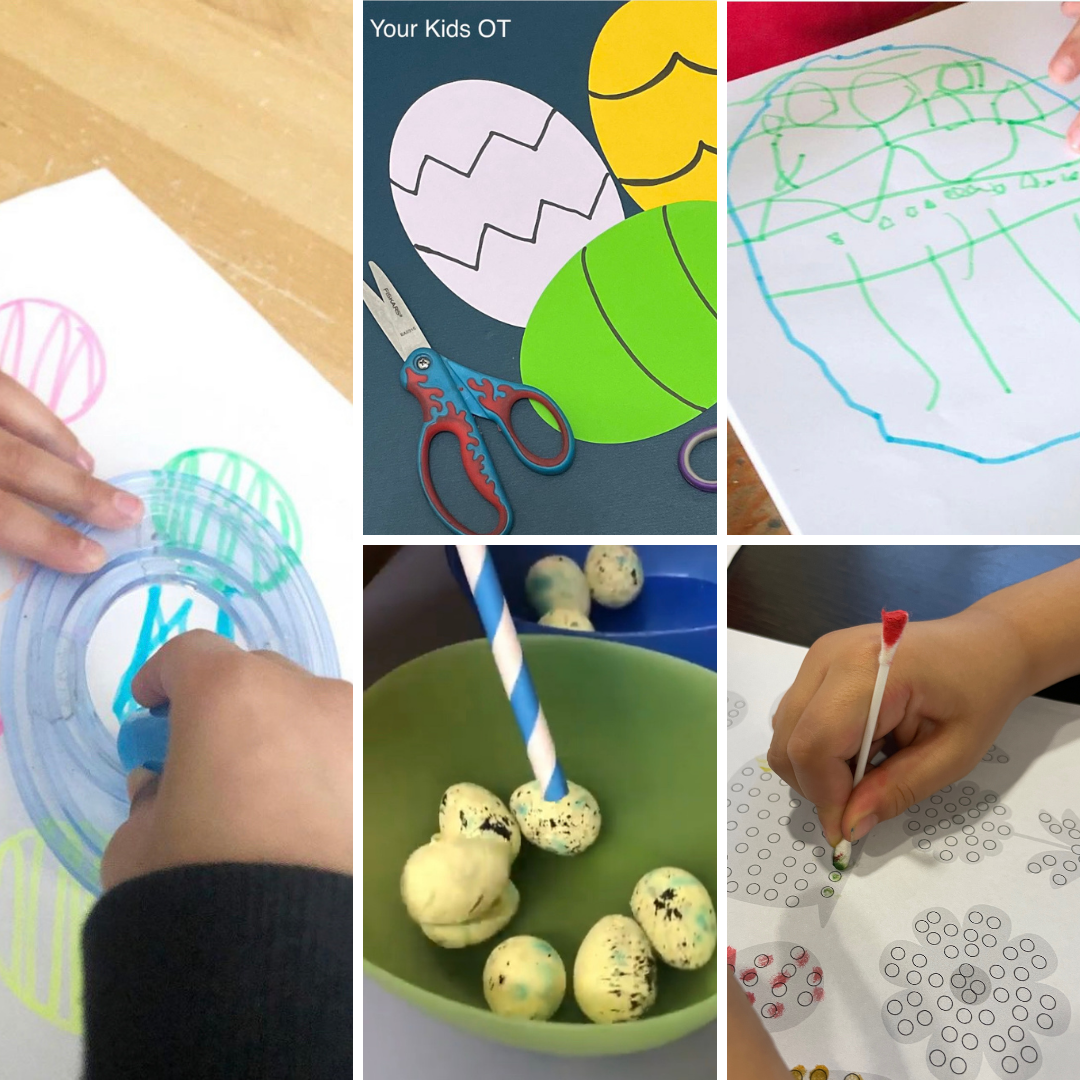 HAPPY EASTER and if you have holidays coming, ENJOY!   Cindy is a registered occupational therapist practising in Sydney, Australia. She has two growing children who are a constant source of inspiration and learning. Cindy loves working creatively to help children to reach their potential, finding opportunities in everyday living and making learning fun. She is also addicted to making printables (even when they take a long time to complete). Cindy is the author of the Occupational Therapy blog Your Kids OT. Read more articles from Your Kids OT at https://www.yourkidsot.com/blog
Cindy is a contributing author of the Functional Skills for Kids Therapy Team. They have together published THE HANDWRITING BOOK, THE SCISSORS SKILLS BOOK and THE TOILETING BOOK. The information on this site is general in nature. The activities are safe for most children, however, you should consult an Occupational Therapist or health professional to address specific movement, sensory or other medical conditions. Affiliate links are used throughout this website to promote recommended products. Your Kids OT receives a small commission if any purchases are made through these links. Please see my disclosure policy for more details. Amazon Store: https://www.amazon.com/shop/yourkidsot YKOT shop: https://www.yourkidsot.com/store/c1/Featured_Products.html Teachers Pay Teachers: https://www.teacherspayteachers.com/Store/Your-Kids-Ot You Tube Channel: https://www.youtube.com/channel/UCZUz_5nYEOCkj32DiOCQo4Q/featured Facebook: https://www.facebook.com/yourkidsot Instagram: https://www.instagram.com/yourkidsot/ Pinterest: https://www.pinterest.com.au/yourkidsot/ 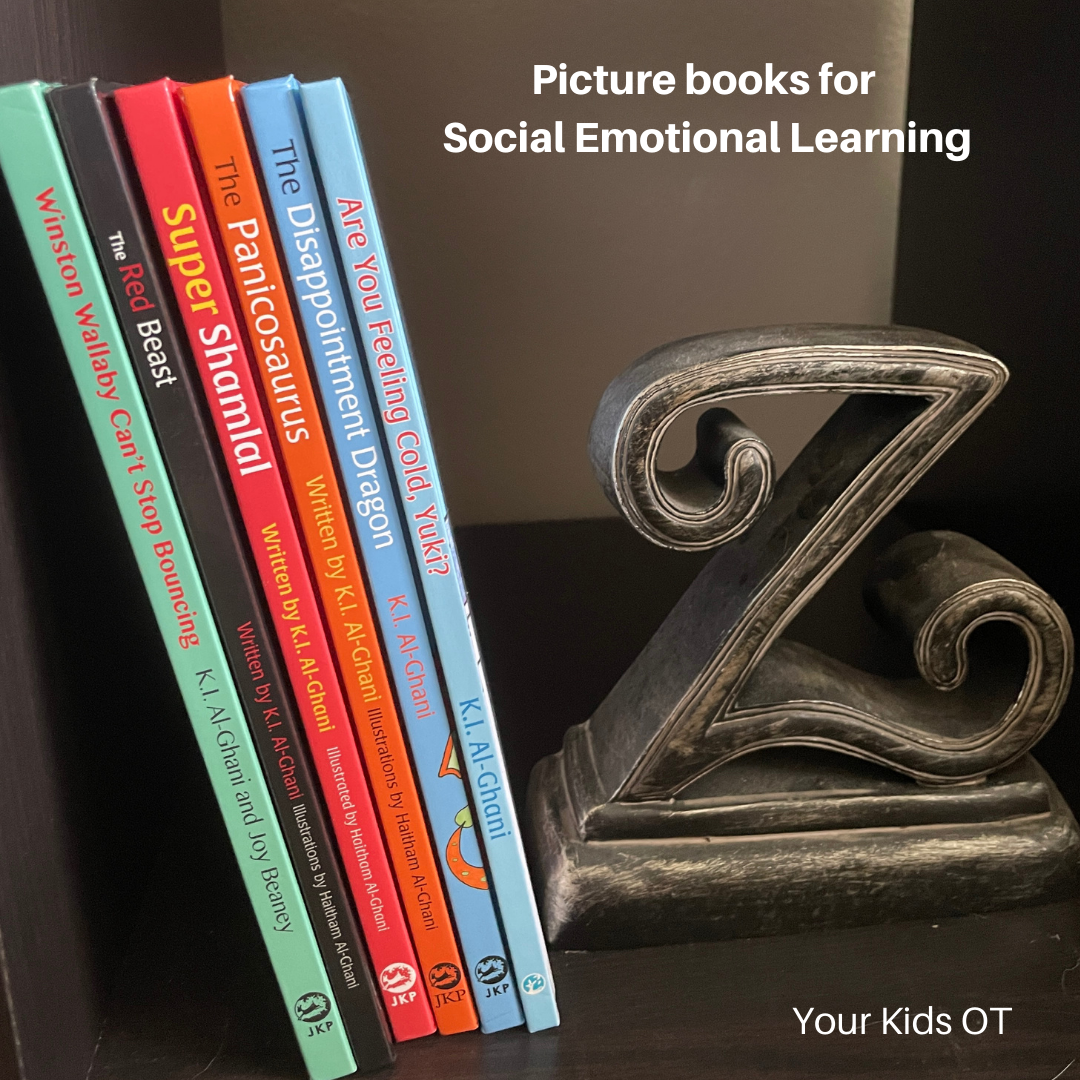 K.I. Al-Ghani is a special educational needs teacher who has worked for more than 35 years. She is currently a specialist teacher for inclusion support, author and mother of an adult son with ASD, Haitham. Haitham is the illustrator of the books which K.I. has authored on social emotional learning. The following is an overview of the books and my personal opinion for review. These books were purchased from various sources including Amazon and Booktopia. This is not sponsored. The books provide a wonderful way to approach tricky subjects with your children with a target audience of approximately 7-11 years. Each book has valuable information for adults (parents, teachers, therapists) with strategies to address the issues. There are lots of practical strategies that the children in the story use and which can be tried by your children too. The books provide children with "emotional literacy". It gives children and adults a shared language to talk about these issues together. Picture books also allow children to relate to the characters or distant themselves from the characters if needed. It may take time or a later discussion to connect some of the issues in the story with themselves. I do find each of the stories a little long and "wordy", so you may have to gauge your child's attention span. Some stories may need to be read in smaller parts or abbreviated. The pictures provide a talking point and a focal point for children to look at. Another way to engage your children whilst reading these books, is to assign an action for certain key words that are repeated. This could include hand or body movements that represent the words. On the whole, I have found that some of the children I'm working with can't manage the extensive language in the books so it is more helpful for the adults in their lives to read the books instead. Here is a closer look at the books. 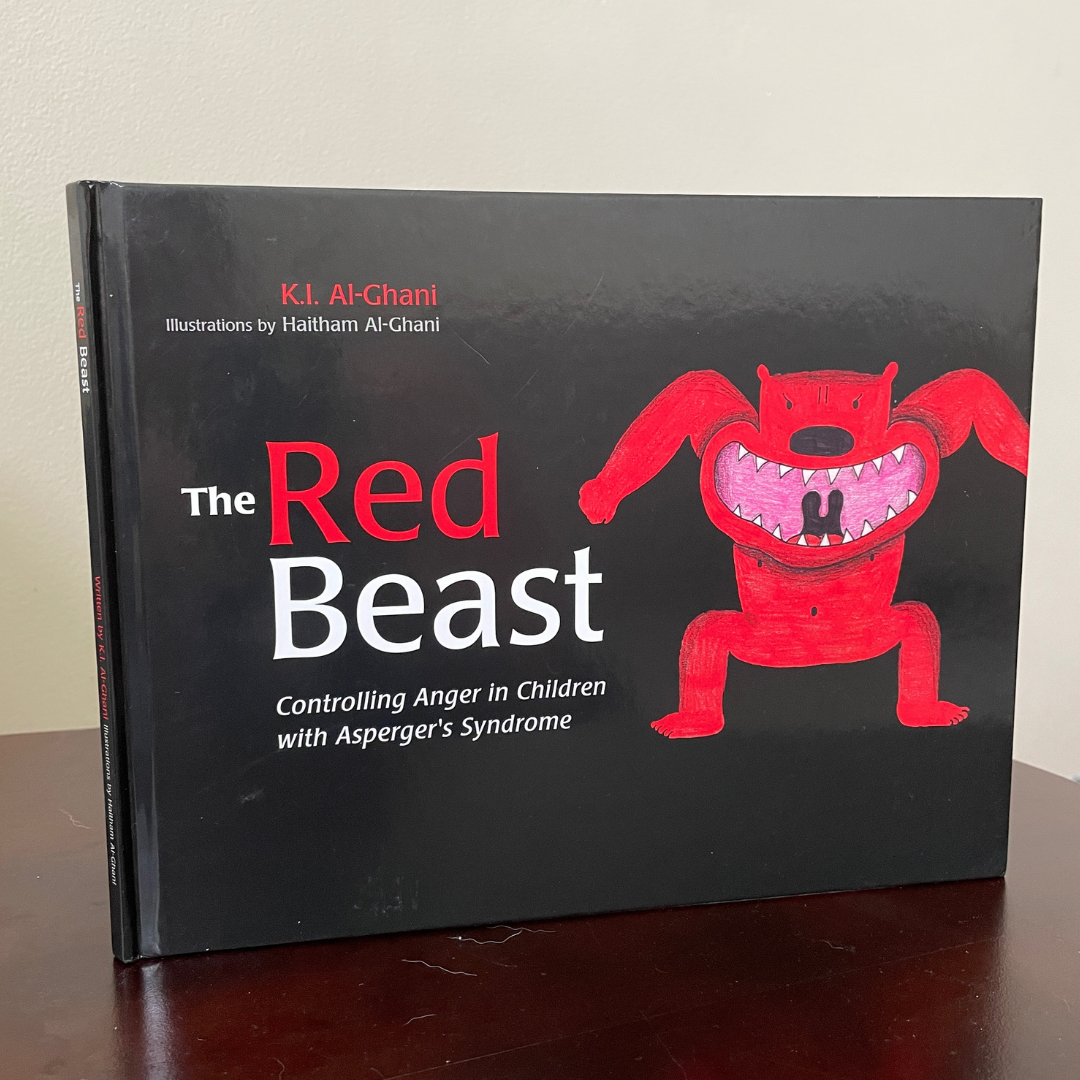 The Red Beast: Controlling Anger in Children with Asperger's Syndrome. Back Cover Synopsis: Deep inside everyone, a red beast lies sleeping. When it is asleep, the red beast is quite small, but when it wakes up, it begins to grow and grow. This is the story of how one boy, Rufus, conquered his anger and sent the red beast back to sleep. Opinion: This picture book deals with a child who loses control of their emotions and lashes out. He is encouraged by teachers to use sensory solutions to calm down. The "taking to the sensory room" is a bit upsetting as the teachers drag him there. However, once in the room they offer strategies like breathing, squeezing a ball, taking a drink, popping bubble wrap. The beast within Rufus calms down and he can return to the classroom. I do enjoy reading this book with children who are working through social emotional regulation. It gives us a talking point for thinking about how people feel, what people are thinking, the size of the problem, the size of the reaction and calm down strategies. I think it misses a few things like empathy for Rufus when he is hit, as it paints Rufus as turning into the red beast (like a scary fairy tale) even though the story is saying it is the beast within him. I do like that when the red beast grows, his eyes and ears get small (letting children know when people get upset that it is hard to hear and see what is going on). You may have to think about how your child might react to this imagery. I think it is also important to emphasize that there is red beast in all of us (which the book does at the beginning) and not to single out one child with this issue of difficulty with anger management. 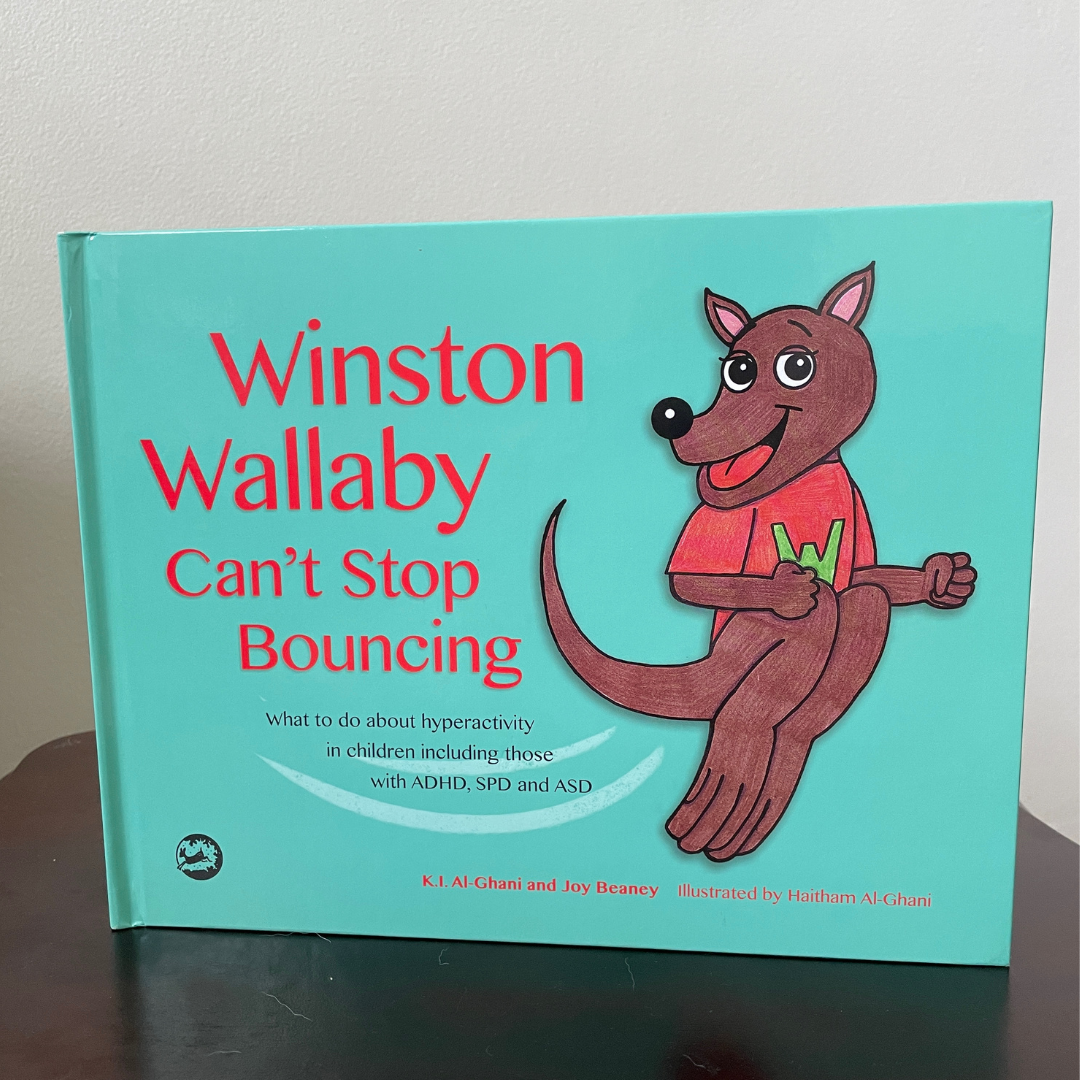 Winston Wallaby Can't Stop Bouncing: What do do about hyperactivity in children including those with ADHD, SPD and ASD. Back Cover Synopsis: Winston Wallaby, like most wallabies, loves to bounce. However, Winston can't seem to ever sit still and when he starts school he needs helps to concentrate...Luckily his teacher Mrs Calm show Winston how to settle down and focus his mind in class, and he learns new ways to help him with touch, feel, attention and awareness. This books was written to help children with ADHD, SPD and ASD to recognize their sensory needs and develop tools to support them. Opinion: This picture books links movement with inattention. It addresses the issue that Winston is trying his hardest but he can't fix the problem on his own. Sometimes his "bouncing" means that he misses instructions, physically hurts someone else or knocks things over. The book shines here when the teacher encourages the whole class to use the sensory strategies so Winston is not always singled out. Whilst Winston has a phrase that he repeats to himself throughout the book "I won't bounce", it would be also great to ask your children to think of other things that he could have told himself (ie. positive self talk).  Panicosaurus: Managing Anxiety in Children including those with Asperger Syndrome. Back Cover Synopsis: Have you ever felt a sense of dread and worry creeping over you? That might be the Panicosaurus coming out to play... Sometimes the Panicosaurus tricks Mabel's brain into panicking about certain challenges, such as walking past a big dog on the street or when her favourite teacher is not at school. With the help of Smartosaurus, who lets her know there is really nothing to be afraid of, Mabel discovers different ways to manage Panicosaurus, and defeat the challenges he creates for her. Opinion: The dinosaur chararacters are linked to parts to the brain to give children information about how our emotions and the brain are connected. Panicosaurus is described as "naughty" from the outset as a trouble maker for the girl character, Mabel. Where the previous book doesn't use "self-talk", this book does! I love the empathy of the fellow students in this book and how the main character is never made to feel "bad" about the difficulties she is experiencing. This book is a great way to talk about what situations might cause a child to be anxious and what strategies they might try. When using this book with one student we created different plans for different situations. I created a Smartosaurus vs Panicosaurus worksheet with a "playground plan". This included a reflection of how panicosaurus might trick us, how our body feels and smartosauraus' plan to solve the problem. 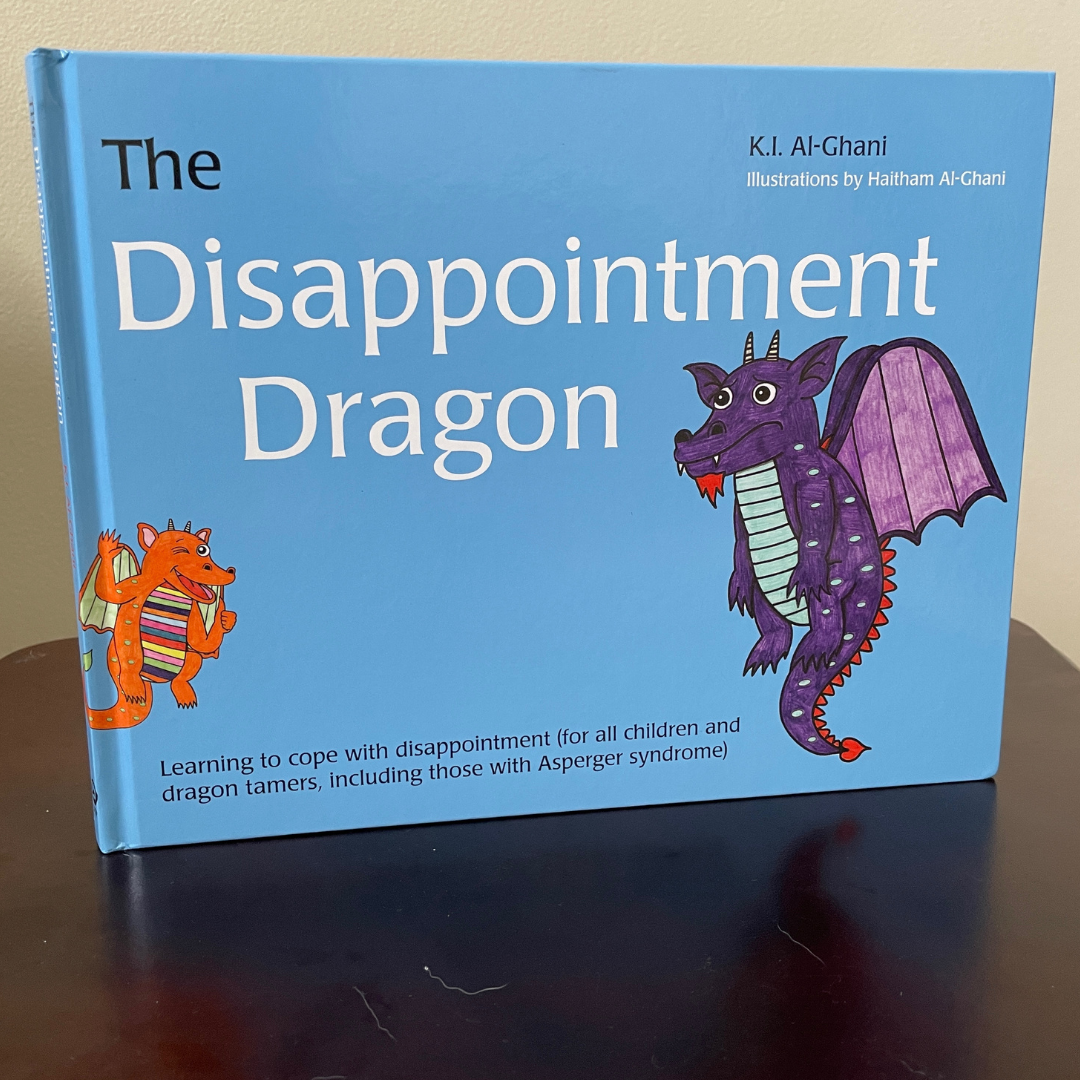 The Disappointment Dragon: Learning to cope with disappointment (for all children and dragon tamers, including those with Asperger Syndrome). Back Cover Synopsis: When things don't go our way, the Disappointment Dragon can come to visit and take us down to his home in the valley of despair... The disappointment dragon visits Bobby when he is not picked for the school football team. He also finds Lucinda when she has to miss an exciting school trip because she has the chicken pox. He even tries to take the whole of Class 3 down to the Valley of Despair when their favourite teacher moves away. Will the Dragon of Hope be able to chase away the Disappointment Dragon and help them to see things more positively? Opinion: This book is divided into 5 stories to introduce and address different ways a child might experience disappointment. This is a difficult topic to address and I have found this is my least favourite of the Al-Ghani picture books. Even though the introduction and the strategy sections of the book warn the adult reading it not to jump in to "fix" the situation and shield children from life's disappointments, I found that the stories do emphasize "banishing" the dragon. When reading these stories (or maybe before), I think it is good to acknowledge that we can all be disappointed and this is a normal reaction when we can't get or do something we want. Maybe it is beyond our control (eg. the weather, or someone else moving) or maybe it is because there are rules that we need to follow (eg. mask wearing, lockdown restrictions). For children, disappointment can hit hard as they can feel that there is very little that they can control or have a voice about. Whilst I agree with the book there are ways to help children to feel more hopeful, there is also more to it that a child might need to work through including perspective, flexible thinking, letting ideas go whilst showing the child empathy. 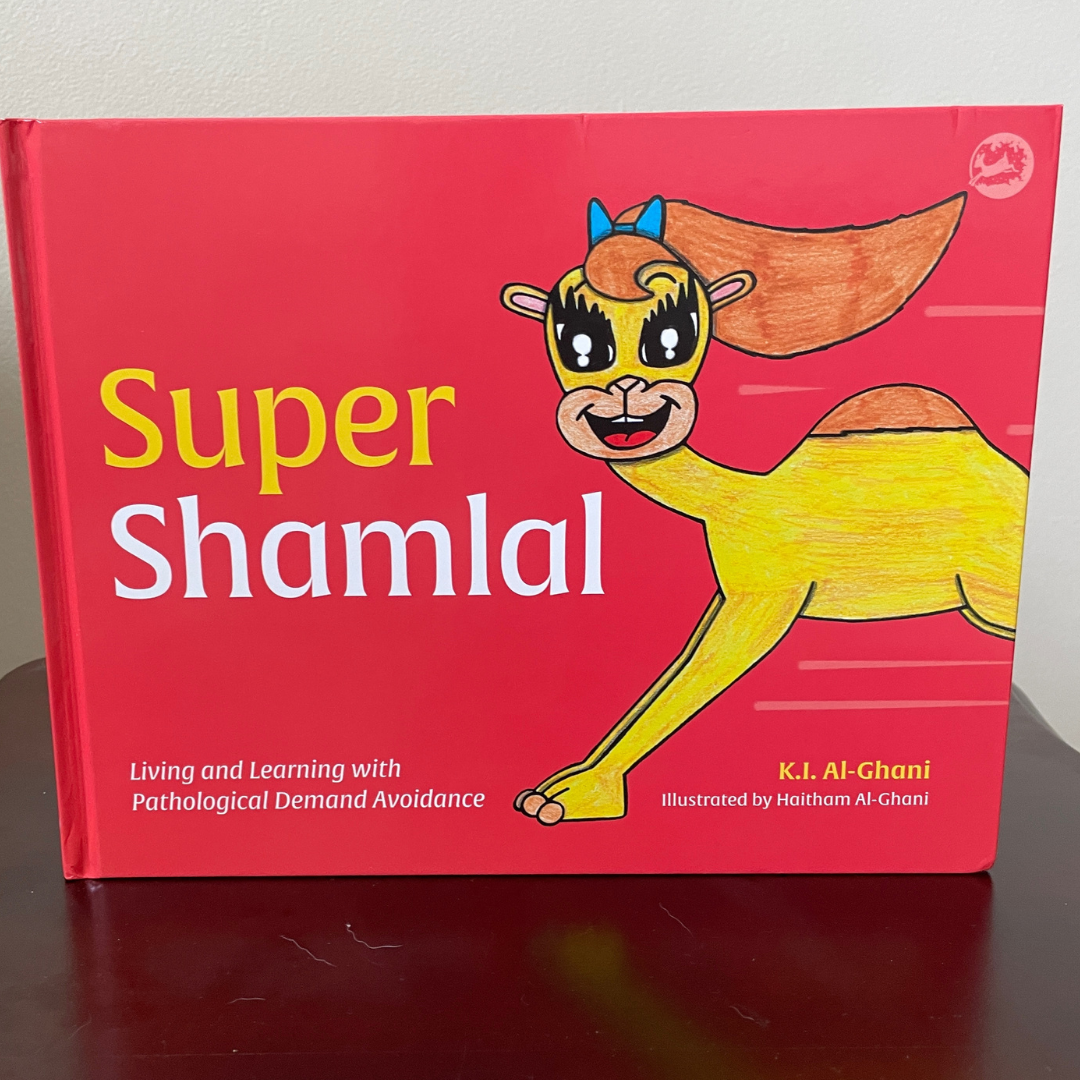 Super Shamlal: Living and Learning with Pathological Demand Avoidance. Back Cover Synopsis: Shamlal the Camel finds it almost impossible to do all the normal, everyday things that the other camels do. Her first word was "NO" and this is still the word she repeats the most throughout every day. Luckily, Shamlal's parents take her to a psychologist who explains that she has PDA, and gives her tips for how to live and learn with it. Opinion: I think this is a wonderful book for adults. The story clearly describes what is like for the camel who experiences panic when asked to do ordinary activities. It provides ways to help someone who is experiencing this to work through SODA (Switch on the thinking brain, oxygen, distraction and approval) and many more fantastic strategies including ask without asking, using humour, work as a double act, variety is the spice of life, handwriting help, using praise, supporting sensory needs, a typical day and more! In the story itself, the camel goes to a psychologist who gives Shamlal the label "Pathologcal Demand Avoidance". I think for the children I work with, having this label or knowing this is what others are thinking of them... is not necesarily helpful to them. It may be helpful for their parents, however many of the children I see are not diagnosed. For my own use, I leave out the diagnosis and also shorten some of the story telling. It is beautiful story telling, however it makes the book very long to read. This may be a good book for parents or teachers to read across several days in a row. 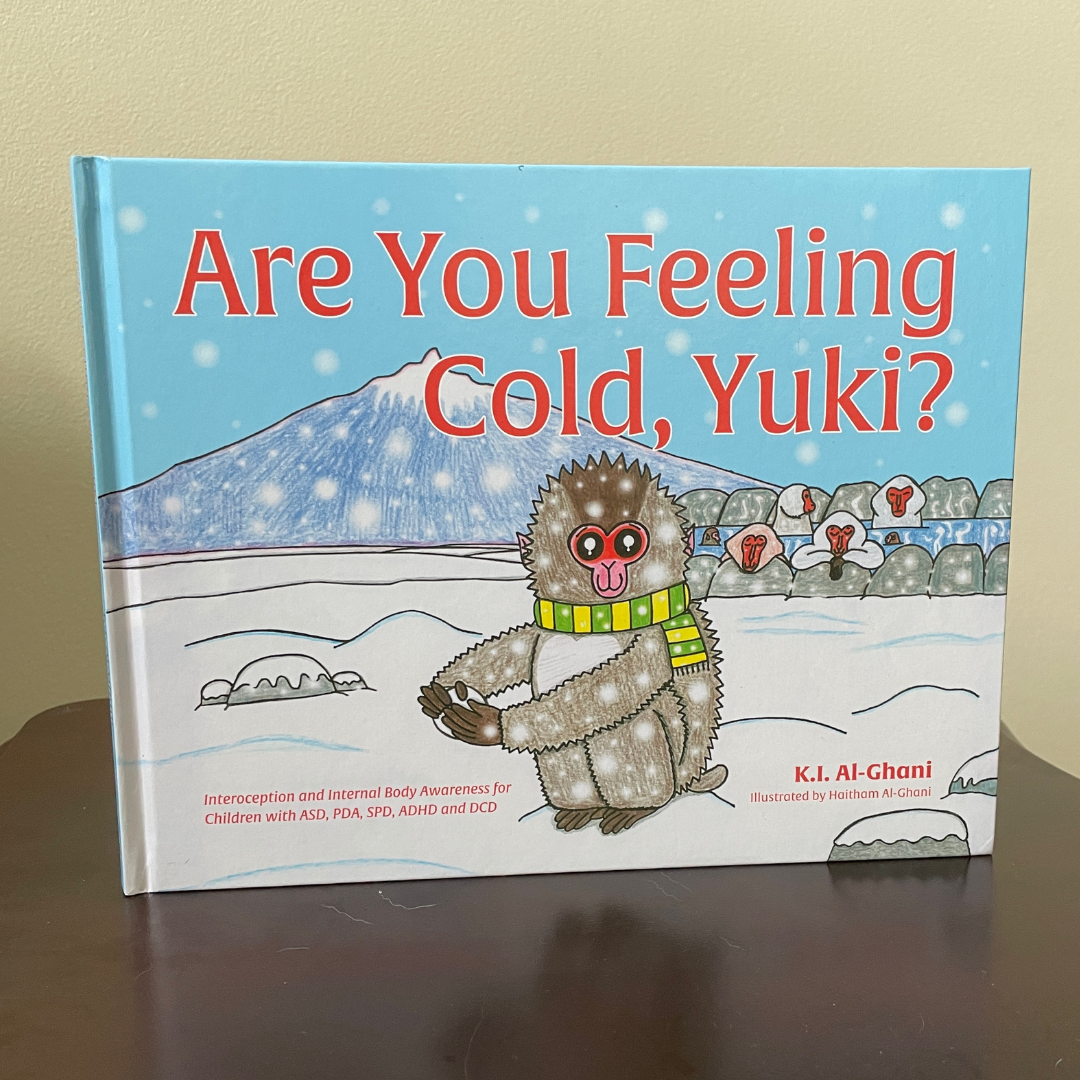 Are you Feeling Cold, Yuki? Interoception and Internal Body Awareness for Children with ASD, PDA, SPD, ADHD and DCD. Back Cover Synopsis: Yuki the snow monkey lives in Japan with his family and friends. He sometimes find it hard to realise when his body is giving him signals, like when he is hungry or cold. Grandfather helps Yuki to understand what his "funny feelings" mean, and what his brain is trying to tell him. This illustrated book will help children to build interoceptive awareness and gain an understanding of the body's activities. It also includes further information for parents and carers, as well as downloaded activities and strategies for building interceptive abilities. Opinion: I love this book! This is probably one of my favourite books in this collection as it keeps the message simple and clear. Grandfather monkey is kind and takes young Yuki through an interoceptive program. He draws the body outline in snow and explains about skin, the brain and body parts. Grandfather then guides Yuki through a series of actvities to bring awareness to sensations in different body parts and feelings (like hunger, the need to toilet and anger). A complete bonus but a brilliant one is access to the downloadable workbook. There are over 40 pages of information and guided interoception activities. Even if you have no other training, this workbook is easy to follow and user-friendly. There is one more book in the series by Al-Ghani called "The Green Eye Goblin" which I have read but don't own. There is also a series of social stories that she has written on Friendship. I have found these stories useful to use with children to talk about different issues which may affect friendships including learning to share, spitting, winning/losing, when to tell on others, obsessions, personal hygiene, personal space, using tact, being taken advantage of and jealousy. Overall, I highly recommend these books as fantastic resources for social emotional learning. They will teach both the adult reader and the child, providing information about the issue and pratical strategies to help address them. Have you read these books? Do you use them? I would love to hear your comments about these books or others you might use for social emotional learning.   Cindy is a registered occupational therapist practising in Sydney, Australia. She has two growing children who are a constant source of inspiration and learning. Cindy loves working creatively to help children to reach their potential, finding opportunities in everyday living and making learning fun. She is also addicted to making printables (even when they take a long time to complete). Cindy is the author of the Occupational Therapy blog Your Kids OT. Read more articles from Your Kids OT at https://www.yourkidsot.com/blog
Cindy is a contributing author of the Functional Skills for Kids Therapy Team. They have together published THE HANDWRITING BOOK, THE SCISSORS SKILLS BOOK and THE TOILETING BOOK. The information on this site is general in nature. The activities are safe for most children, however, you should consult an Occupational Therapist or health professional to address specific movement, sensory or other medical conditions. Affiliate links are used throughout this website to promote recommended products. Your Kids OT receives a small commission if any purchases are made through these links. Please see my disclosure policy for more details. Amazon Store: https://www.amazon.com/shop/yourkidsot YKOT shop: https://www.yourkidsot.com/store/c1/Featured_Products.html Teachers Pay Teachers: https://www.teacherspayteachers.com/Store/Your-Kids-Ot You Tube Channel: https://www.youtube.com/channel/UCZUz_5nYEOCkj32DiOCQo4Q/featured Facebook: https://www.facebook.com/yourkidsot Instagram: https://www.instagram.com/yourkidsot/ Pinterest: https://www.pinterest.com.au/yourkidsot/ 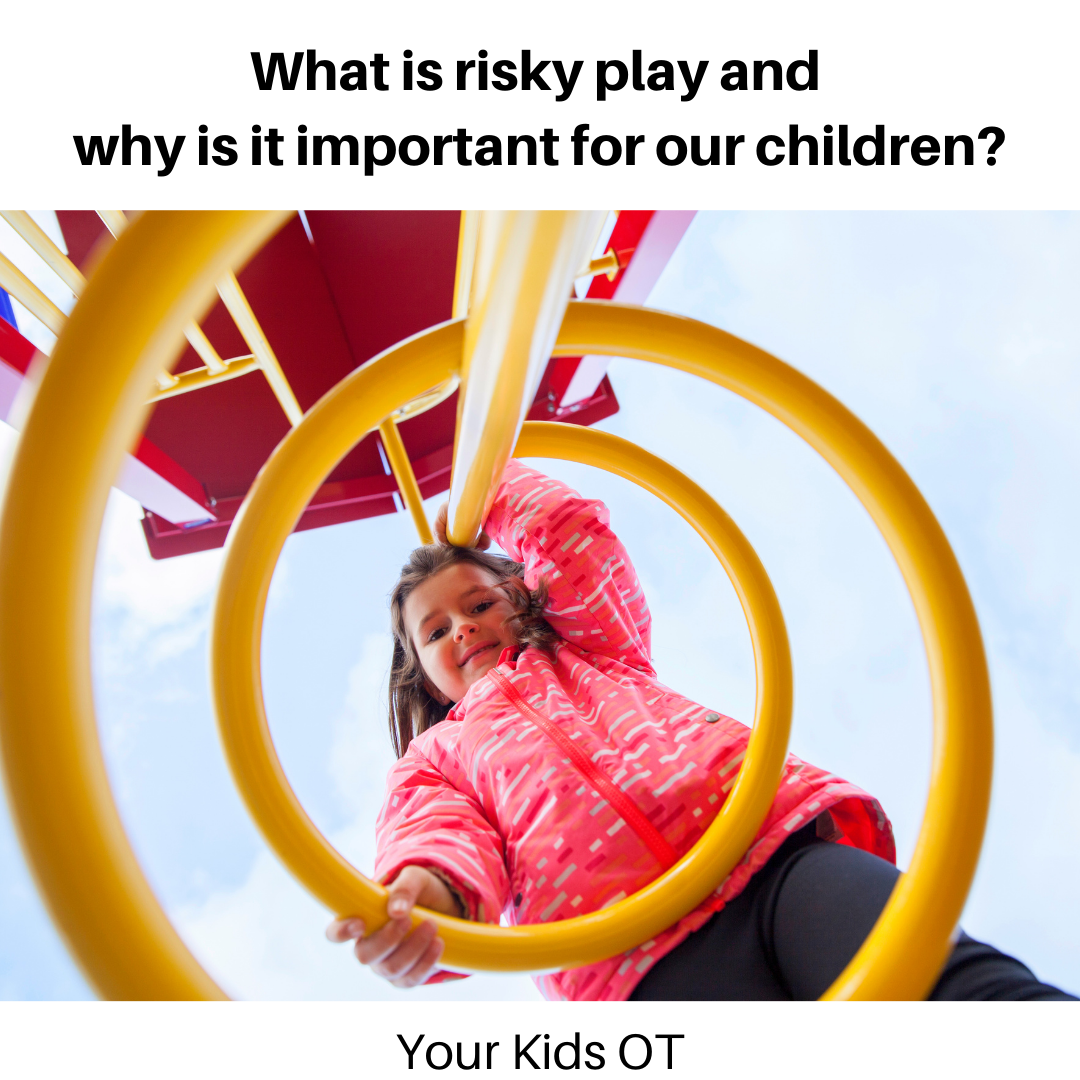 Children learn through play. They learn by doing, experiencing things for themselves. We want our children to be safe, however risk tasking is an essential feature of play and healthy childhood development. I was recently interviewed by a current affairs television program about a local playground which has been controversial with some parents regarding it's risks. The segment understandably hasn't aired (and may not air) as I think there have been and continue to be bigger issues in the world right now. I thought I would share some of my thoughts on risky play for children with you here. Australian Playground Safety Standards On the 30th August, 2017 the Australian Standards issued a new Playground Safety Standard for the development, installation, inspection, maintenance and operation of playgrounds. The objective of AS 4685.0 is to minimize the risk of injury to playground users. Professor David Eager, Chairperson of the Technical Committee CS-005, Playground Equipment, "Risk is an inherent feature of playtime and there are many acceptable risks as part of a stimulating and challenging learning environment. The solution is not to wrap kids in cotton wool; the standard is all about challenging children and developing important life skills. AS 4685.0 introduces a risk benefit analysis technique that allows operators and owners of playgrounds to quantify their exposure to hazards using techniques that are simple to apply. Then they can make evidence-based decisions with regard to the maintenance, repairs and the timely replacement of their assets” . CEO of Standards Australia, Dr Bronwyn Evans said “the standard helps promote one of the joys of an Australian childhood. In a world that is increasingly digital it is important that children enjoy physical play environments as well,” added Dr Evans.* 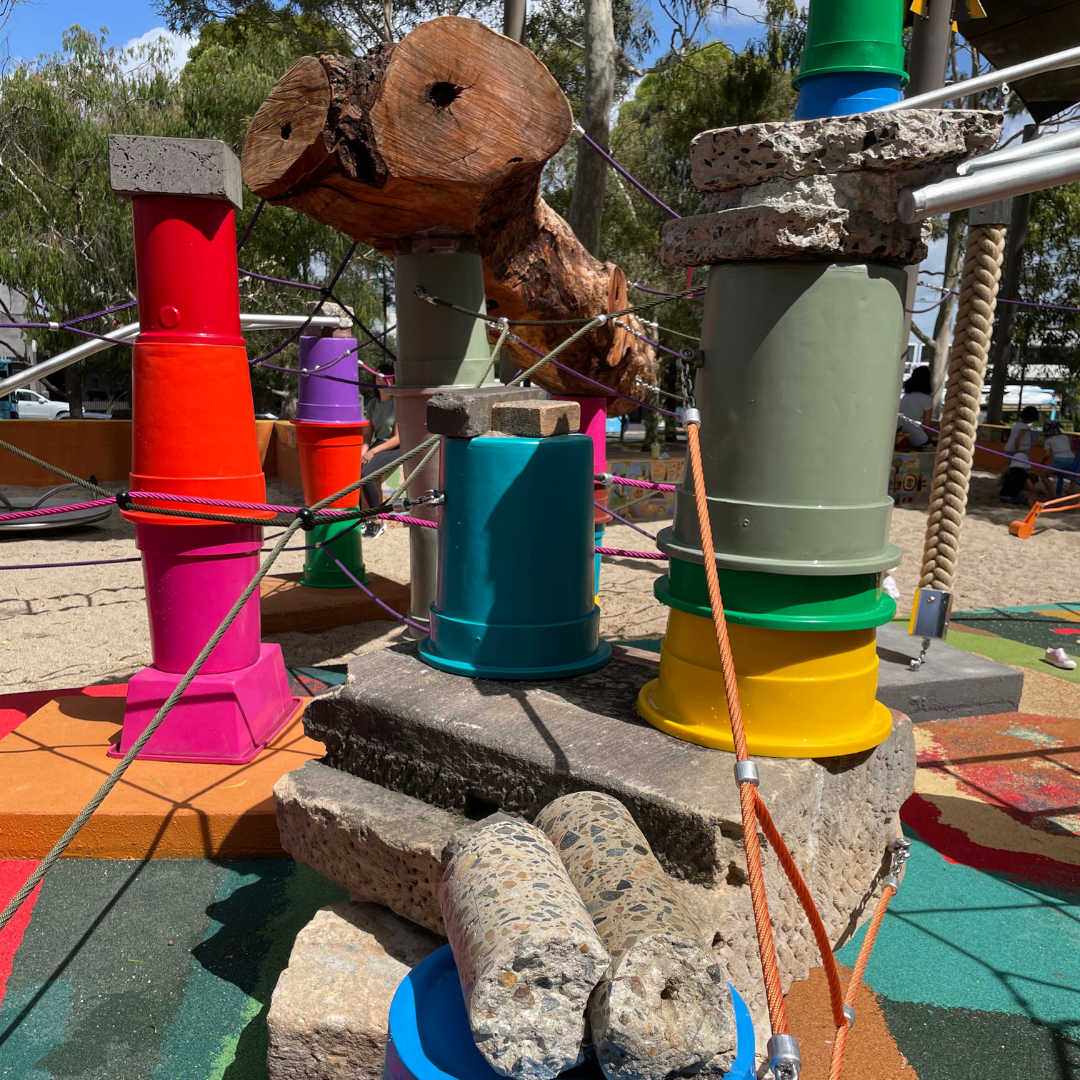 Pioneers Memorial Park playground in Leichhardt Playgrounds in general provide a hands-on opportunity for children to learn about their bodies and the environment that they are interacting with. When you include risky elements in play, children can challenge themselves to try new things and work out what is an acceptable risk for them. There are opportunities for children to have physical challenges with bodies... their balance, their strength and movement. In an experiential and experimental way; children can work out how far, how high, how heavy or how wobbly something is. They can work it out for themselves and make adjustments. Beyond the physical development, educators and occupational therapists get excited by the social emotional skills that are gained from these experiences. Children learn problem solving – trying different ways to work something out, perseverance – trying things over and over, resilience – how to react when something doesn’t work and confidence when something is achieved. This can be impactful to a child's self esteem and also help them to know when to ask for help. What can parents do? Risky play does not mean unsupervised play. It is not an excuse for parents to be looking at their phones rather than their children. I love my phone as much as the next person; but playgrounds should be seen as opportunities for interaction, engagement and supervised play. We as parents can help our children to manage their risks. Firstly, we can stop ourselves from jumping in too quickly to solve the problems. Supervised play does not mean making every decision for our child. We can help our children by giving them the opportunity to problem solve and learn the consequences of their choices. We can help our children to look at a situation or problem from a different perspective – I wonder if that log would work? I wonder if we pushed instead of pulled what would happen? Is that bridge going to be wobbly? What if we held on with two hands? We can help our children with positive self-talk such as “I can do this. Let me try again. I’m not giving up.” We can help our children to try new experiences whether that be climbing a little higher than they have before, spinning on something, touching a new texture, balancing with no hands holding or whatever the new experience might be. Finding a challenge Some children are natural risk takers and others are not. Read more about helping children to manage risks and hazards with the Kidsafe (Child Accident Prevention Foundation of Australia). 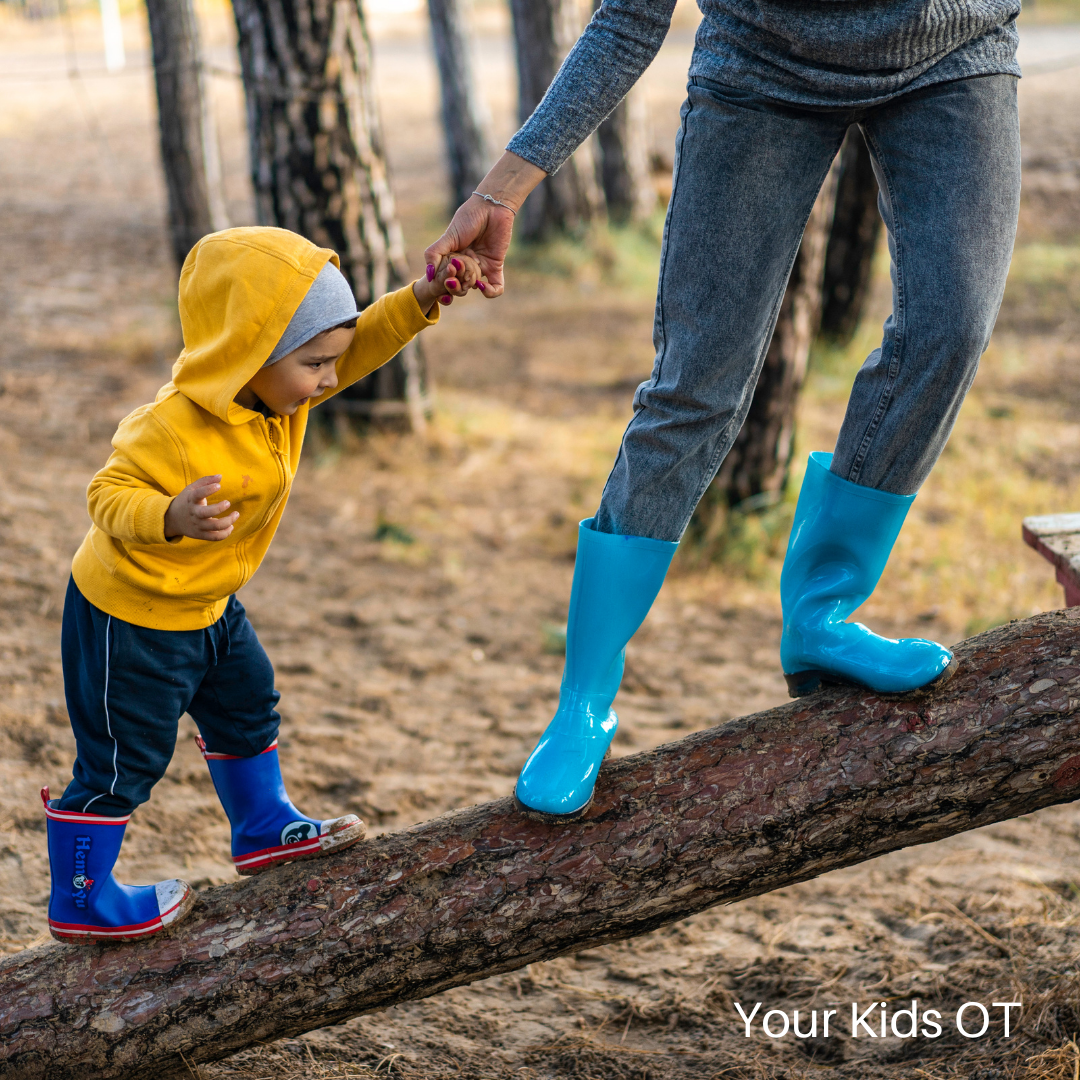 We want our children to be risk-takers rather than risk-adverse. We want them to try new things even if that means that they won't be successful. We want them to be problem-solvers and want them to build resilience. We want our children to have the opportunities to develop self esteem and confidence by achieving things for themselves. Children are constantly processing all of the information around them from their own bodies and the environment. Learning through experience, exploration, play and taking risks means that they can learn how to regulate and organize their bodies for daily challenges they might face in life. Are you allowing your child to take risks?   Cindy is a registered occupational therapist practising in Sydney, Australia. She has two growing children who are a constant source of inspiration and learning. Cindy loves working creatively to help children to reach their potential, finding opportunities in everyday living and making learning fun. She is also addicted to making printables (even when they take a long time to complete). Cindy is the author of the Occupational Therapy blog Your Kids OT. Read more articles from Your Kids OT at https://www.yourkidsot.com/blog Cindy is a contributing author of the Functional Skills for Kids Therapy Team. They have together published THE HANDWRITING BOOK, THE SCISSORS SKILLS BOOK and THE TOILETING BOOK. The information on this site is general in nature. The activities are safe for most children, however, you should consult an Occupational Therapist or health professional to address specific movement, sensory or other medical conditions. Affiliate links are used throughout this website to promote recommended products. Your Kids OT receives a small commission if any purchases are made through these links. Please see my disclosure policy for more details. Amazon Store: https://www.amazon.com/shop/yourkidsot YKOT shop: https://www.yourkidsot.com/store/c1/Featured_Products.html Teachers Pay Teachers: https://www.teacherspayteachers.com/Store/Your-Kids-Ot You Tube Channel: https://www.youtube.com/channel/UCZUz_5nYEOCkj32DiOCQo4Q/featured Facebook: https://www.facebook.com/yourkidsot Instagram: https://www.instagram.com/yourkidsot/ Pinterest: https://www.pinterest.com.au/yourkidsot/
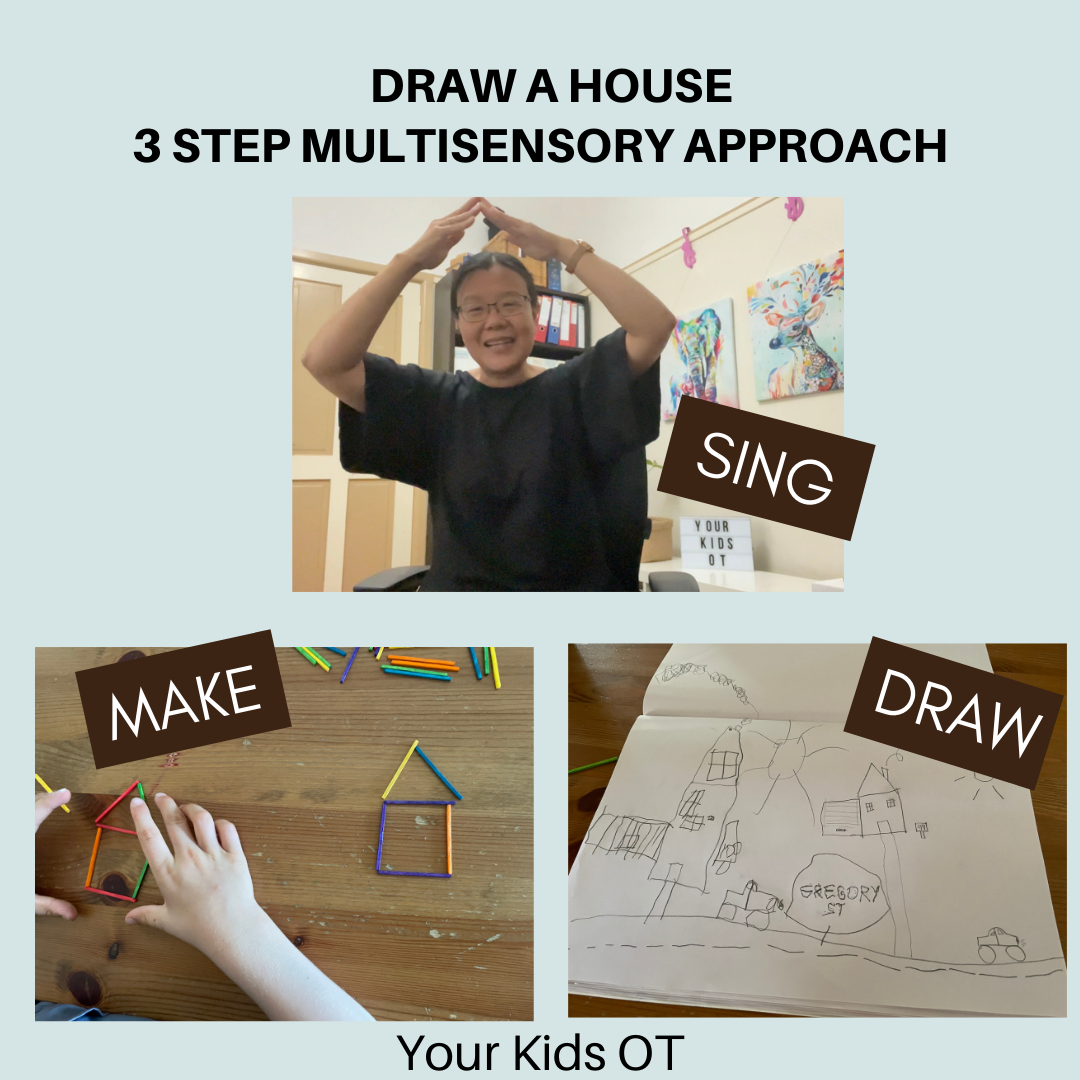 Drawing is a stage of development where children are assigning meaning to marks on the page. Lines and shapes positioned together become representations of objects and people. As the child develops those lines and shapes are used in handwriting to form letters and numbers. As an occupational therapist, I use a multisensory approach for teaching children to draw. This helps guide a child to associate the object with the drawing...in this case a house. A multi-sensory approach is an engagment of the whole body during learning. It helps with visual spatial skills, motor planning and memory of the activity. Each of the three steps that I'm using to teach drawing includes singing a song about a house. Music and singing is a wonderful way for children to have a repetitive way to sequence and recall different components for drawing a house. I'll outline the three step approach below; however this process is best observed via the video that I've recorded. You will find the you tube linked here on the website or if you are reading this email use this link HERE. 1. SING AND ACTIONS Here's a house with a wall (hold up one arm vertically and keep it up) with a wall (hold other arm vertically and keep it up) with a wall (keep both arms up). Here's a house with a floor (place one arm horizontal and hold) with a floor (place other arm horizontal on top and hold) with a floor (keep both arms horizontal). Here's a house with a roof (place one arm diagonally above head and hold) with a roof (place other arm diagonally above head with fingers touching other arm and hold) with a roof. HERE COMES THE WIND (make blowing noises and arms shake) There's no house any more any more (arms are lowered and you can also fall down). There's no house any more. Repeat the song and actions several times. 2. SING AND MAKE I use matchsticks to help children to make the house. Match sticks are a good size to encourage a small drawing. Alternatives you might use include wikki stix, pipe cleaners, craft sticks or even pencils. Sing the song again and instead of doing the hand actions, place down a match stick for each wall, the floor and the roof. I like to join the house into a square before adding a roof. Have your child make their house next to yours and as you sing. Slow down the singing if needed to allow time for the "making". 3. SING AND DRAW After the child has learnt how to make a house, you can then introduce a pencil. You may leave the model of the matchstick house for your child to observe. I like to draw the house with the child so that they are imitating my strokes and direction. This helps children with the visual motor planning needed to draw. I use the same steps to draw as I did in placing the matchsticks (ie. the same order as I sing). Have your child draw their house next to yours and as you sing. Slow down the singing if needed to allow time for the "drawing". Encourage your child to sing along at every step! Watch as I use this three step approach - sing and actions, sing and make, sing and draw. Depending on your child's age and developmental ability; you may need to do these steps over several days or weeks. If your child is a little older, then you could possibly do all three steps within one sitting. YOU TUBE LINK: DRAW A HOUSE WITH ME Have you tried a multisensory approach to drawing? What other songs could you adapt in the same was that I've adapted this song? I would love to try out your ideas too so comment below, tag Your Kids OT on Instagram or send me an email cindy@yourkidsot.com.   Cindy is a registered occupational therapist practising in Sydney, Australia. She has two growing children who are a constant source of inspiration and learning. Cindy loves working creatively to help children to reach their potential, finding opportunities in everyday living and making learning fun. She is also addicted to making printables (even when they take a long time to complete). Cindy is the author of the Occupational Therapy blog Your Kids OT. Read more articles from Your Kids OT at https://www.yourkidsot.com/blog Cindy is a contributing author of the Functional Skills for Kids Therapy Team. They have together published THE HANDWRITING BOOK, THE SCISSORS SKILLS BOOK and THE TOILETING BOOK. The information on this site is general in nature. The activities are safe for most children, however, you should consult an Occupational Therapist or health professional to address specific movement, sensory or other medical conditions. Affiliate links are used throughout this website to promote recommended products. Your Kids OT receives a small commission if any purchases are made through these links. Please see my disclosure policy for more details. Amazon Store: https://www.amazon.com/shop/yourkidsot YKOT shop: https://www.yourkidsot.com/store/c1/Featured_Products.html Teachers Pay Teachers: https://www.teacherspayteachers.com/Store/Your-Kids-Ot You Tube Channel: https://www.youtube.com/channel/UCZUz_5nYEOCkj32DiOCQo4Q/featured Facebook: https://www.facebook.com/yourkidsot Instagram: https://www.instagram.com/yourkidsot/ Pinterest: https://www.pinterest.com.au/yourkidsot/ You may also like:
|
AuthorHi, I'm Cindy and I am an Occupational Therapist. I enjoy working creatively with children to see them reach their potential. Read more about me here. 
SEARCH THIS SITE
Archives
April 2024
Categories
All
Popular Posts
 |
 RSS Feed
Join the YKOT e-newsletter!
Subscribe to get our latest content by email and receive
the SHAPE ROADS PRINTABLE NOW!

Success! Now check your email to confirm your subscription and receive your free printable!
Join our Mailing List!
Subscribe to get our latest content by email and receive
the SHAPE ROADS PRINTABLE NOW as a thankyou!
Success! Now check your email to confirm your subscription and receive your free printable!
Disclaimer: The information on this site is general in nature and should be used for educational and entertainment purposes. The activities are safe for most children, however, you should consult an Occupational Therapist or health professional to address specific movement, sensory or other medical conditions. This blog does not replace formal therapeutic professional advice given by a health professional or medical practitioner. Reviews and endorsements of products will only be made based on my expertise and personal opinion; and deemed worthy of such endorsement. The opinions shared in sponsored content will always be my own and not that of the advertising company or brand. Content, advertising space or posts will be clearly identified if paid, affiliated or sponsored. Affiliate links may be found throughout this website in advertising. This means that if you follow through with a purchase from these links, Your Kids OT will receive a percentage of the sale. Your Kids OT undertakes to meet the requirements of the "Social Media Policy" as published by Australian Health Practitioner Regulation Agency (AHPRA). Further information about this policy can be found here.
Find meFollow me |
|
About me
AuthorHi, I'm Cindy and I am an Occupational Therapist. I enjoy working creatively with children to see them reach their potential. Read more about me here. 
|
Copyright © 2017 Your Kid OT