
 “But they can do it at OT!” It's a phrase many of us have heard (or said). A child might successfully complete a task during a therapy session, follow the steps, use the strategy and even demonstrate a new skill. Then they return to the classroom or home environment and… it's as though the skill never happened. So what happened? Learning a skill in one situation doesn't automatically mean a child will use it somewhere else. The people, environment, sensory demands, task expectations and level of support can all change. Even presenting the same task in a different way can cause some children to stumble. Tying a different set of shoelaces on a different pair of shoes can feel like a completely new task! Children learn through seeing, hearing, touching, moving, thinking, using working memory, doing and practising. When we deliberately draw on these different ways of experiencing information, we can provide more opportunities for a child to understand, practise and remember a skill. What is multisensory learning? A multisensory approach involves using more than one form of sensory input or prompt to support learning. This might include:
The multisensory experience provides useful information and feedback that can help the child understand, experience, practise or remember the skill. My previous article, “Draw with me: A three step multisensory approach,” explores how I have used music, movement and repetition when teaching drawing skills.  Individualising multisensory learning A multisensory approach can also take account of individual differences in sensory processing. Winnie Dunn's Sensory Profile framework provides one way of understanding how people notice and respond to sensory information. The framework considers the interaction between neurological thresholds and self-regulatory responses. It describes four broad patterns: Bystander, Sensor, Seeker and Avoider. Read more about the Sensory Profile framework here. These patterns aren't fixed categories. A child's responses can vary depending on the sensory system, activity, environment and context. Children can also demonstrate different patterns across different situations. This has important implications for multisensory learning. A child who tends to miss sensory information may benefit from information being made more noticeable. Another child may notice sensory information very quickly and need input reduced so they can focus on what is relevant. A child who actively seeks sensory experiences may benefit from appropriate opportunities for movement and interaction, while a child who avoids particular sensory experiences may need increased predictability, choice or adaptation. The same sensory strategy won't necessarily work for every child. Adding a cognitive strategy The Cognitive Orientation to daily Occupational Performance (CO-OP) approach provides another useful way of thinking about learning and carryover. CO-OP is a goal-directed, problem-solving approach that actively involves the child in developing strategies to improve their occupational performance. A central feature is the Goal–Plan–Do–Check process: GOAL – identify what the child wants to achieve. PLAN – develop a strategy for achieving it. DO – put the plan into action. CHECK – evaluate how it worked and make adjustments. This changes the role of the child from someone who just follows an adult's instructions to someone who is engaged with participation. When we combine multisensory learning with a cognitive strategy such as CO-OP, we can support children to notice what they are experiencing, develop strategies, test them and make adjustments. This can also support the development of executive functioning skills such as planning, monitoring, problem-solving and cognitive flexibility. We can build habits and affect memory. Repeating actions creates automatic routines, and these routines physically change and strengthen the brain systems responsible for storing and recalling information.  Prompts can support learning and carryover Children need different levels of prompting to learn and carry over their skills. In my article Prompt Hierarchy Explained!, I discuss different levels of prompting and considerations for moving from “most to least” or “least to most” support. Prompts might include:
Prompts can form part of multisensory teaching. A child might receive a visual cue alongside a verbal instruction, or a physical cue alongside a demonstration. Over time, the aim is for the child to require less adult input and become increasingly able to initiate, monitor and adjust their own performance. The child may respond to natural cues. Generalisation (carryover) is more than repetition Carryover isn't simply about practising a skill many times. A child might practise a skill repeatedly in a therapy room but have difficulty using it in the classroom because the environment, task demands or level of support are different. Meaningful practice helps bridge the gap.
 Pencil grasp as an example Pencil grasp provides a useful example of how these ideas can come together. My co-author Jaime Spencer has written specifically about How Kids Learn Pencil Grasp. Her article explores the learning process and teaching supports specific to pencil grasp. Spoiler alert but songs, posters and visual cues actually work! A child learning about pencil grasp might first need to see what an efficient grasp looks like. A poster or visual reminder can provide that information without an adult having to repeat the instruction every time. They can then feel and experience the grasp while using a pencil, receive feedback from their fingers and hand, and practise it during meaningful drawing and writing activities. The visual information can remain available in the classroom or at home, providing a consistent reminder when the therapist isn't there. This is one of the reasons we included visual posters in Gripipedia. The posters aren't intended to replace teaching or become another checklist of “correct” pencil grasps. Instead, they are designed to provide accessible visual information that can support teaching, discussion and carryover. Teachers and parents can use the same visual language as the therapist, helping to create consistency across environments. The poster can become a prompt that the child eventually uses independently. That is the shift we are looking for: from adult prompt → to visual cue → to self-monitoring → to independent use. Gripipedia is now on sale! Find out more with the link below ! We hope to see you at the webinar!  
0 Comments
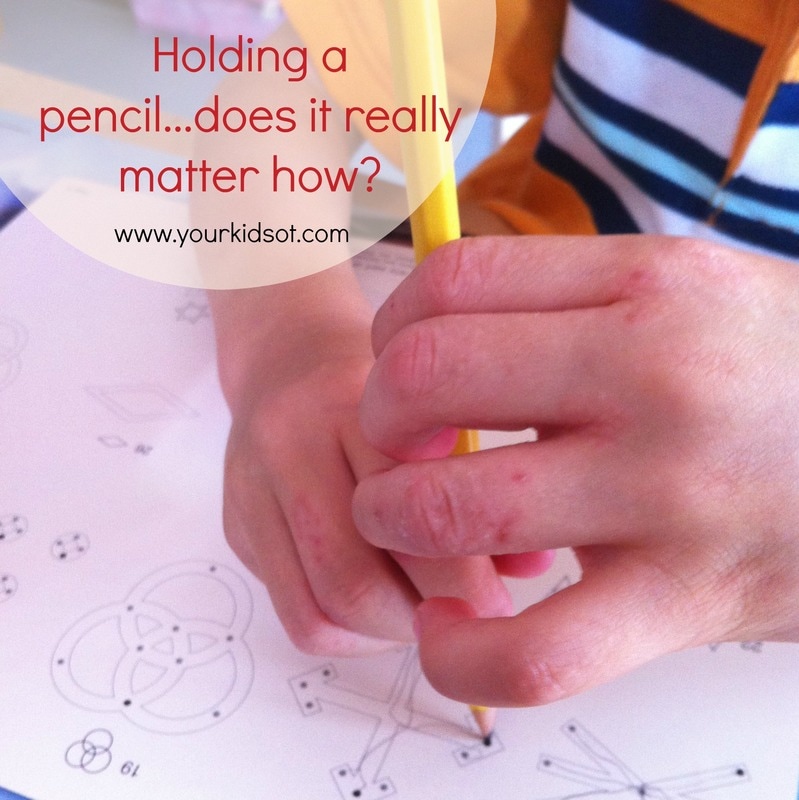
 When we look at a child's pencil grasp, it can be tempting to focus on what the fingers are doing. Is it a tripod grasp? A quadrupod? A lateral grasp? Is the pencil being held “correctly”? But pencil grasp is only one piece of the puzzle. As occupational therapists, we need to consider the bigger picture: the child, the task and the environment and how all of these factors come together to influence pencil control, handwriting and participation. I've been sharing about these concepts over a number of years. Here are some of the pieces of the puzzle worth considering. 🧩 Pencil grasp and control
Read: Losing Pencil Control. Pencil Grasp Does Matter!
Read: What If My Child Can't Use a “Normal” Pencil Grasp? Should I Change It? 🧩 Furniture and environment
Read: Size Matters: Furniture Fit for Function
Read: The Why and How of Vertical Surfaces 🧩Posture & Body Stability Gross Motor Skills Needed for Page Stabilization During Writing Core strength, bilateral coordination and shoulder stability, influence handwriting and pencil control. They are needed to help with page stabilisation during handwriting tasks. Read: Gross Motor Skills Needed for Page Stabilization 🧩 Hand function for self-care Hands don't only have to manage pencils! The same developing hand skills are used across many everyday occupations, including managing buttons, zips, fasteners, cutlery, toothbrushes and other self-care tools. If a child has difficulty with pencil control, they often have difficulty with these self-care tasks. Typing is not always the quick solution either.
Read: Fine Motor Skills with a Marble (or Ball)!
🧩 Handwriting legibility Ultimately, pencil grasp is not the end goal. We want to consider what the child can do with the pencil. Can they form letters? Are letters an appropriate size? Is spacing consistent? Can they maintain alignment? Can someone else read what they have written?
Read: Orthography, Handwriting Legibility and OT
Read: Top Tips for Teaching Handwriting   🧩 Visual Motor Integration skills Handwriting also relies on visual and visual-motor integration skills. Children need to take in visual information, remember it, organise it in space and translate what they see into written output.
Read: Visual Perceptual Skills Required for Handwriting 🧩 Task demands Writing one sentence on a whiteboard is different from copying a paragraph. Writing a name is different from completing a page of written work. Writing for five minutes is different from writing for thirty minutes. The length, speed, complexity and purpose of the task can all change the demands placed on the child.
Read: Everyday Writing… Encouraging Reluctant Writers 🧩 Endurance and fatigue Sometimes a child's pencil grasp looks perfectly manageable at the beginning of a task but changes as the task continues.
Putting the pieces together This puzzle is far from complete! There are many other factors that can influence how a child approaches and participates in a handwriting or pencil task. Bilateral integration helps a child coordinate both sides of the body, including using one hand to stabilise the paper while the other writes. Crossing the midline can influence how a child moves across the page and maintains an efficient working position. Attention and executive functioning can affect the ability to stay engaged, remember instructions, plan what to write and manage multiple demands at once. Motivation, interest and engagement matter too. A child may demonstrate very different skills depending on how meaningful, challenging or enjoyable the task is. Sensory needs, regulation, motor planning, learning differences and the individual context of the child can also become important pieces of the puzzle. When we're trying to understand a child's pencil use or handwriting, we need to consider the whole picture:
Would you like to explore pencil grasp and control further? Gripipedia: Your Guide to Pencil Grips and Grasp is a practical resource for OTs, educators and others who want to better understand pencil grasp, evaluate pencil use and make informed decisions about when and how to intervene. Watch the unboxing of the book! Gripipedia is now on sale! 
 Introducing Gripipedia! 2 Occupational Therapists. 2 Countries. New York USA ↔ Sydney AUSTRALIA 9 years of collaboration. Hundreds of hours of research. Thousands of online meetings. Countless conversations. Edits and edits and more edits. 1 shared passion. 1 purpose. 1 book. Gripipedia is your guide to pencil grips and grasp. It takes the research and guesswork out of supporting pencil grasp. It’s packed with evidence-based information on grasp fundamentals, models pencil grasp evaluation and description, provides a decision guide for intervention, targeted strategies and resources to make carryover into the classroom and home seamless. We believe, Gripipedia is the resource that every paediatric occupational therapist needs. Let's take a look inside!  Section 1. Pencil Grasp Fundamentals A foundation for understanding how pencil grasps develop, why children use different grasp patterns, and what makes a grasp functional. This section moves beyond simply labelling a grasp as “correct” or “incorrect” and explores the development, mechanics and function of pencil grasp. Chapters include research, MTSS, developmental progression, anatomy, joint laxity and fine motor skills. Section 2. Evaluation of Pencil Grasp Not sure whether a pencil grasp needs to be changed? We have created an evaluation form and decision guide to provide a practical framework for observing and evaluating pencil grasp, considering the child, the task and the environment. It supports clinical reasoning and helps you decide when to intervene, when to adapt, and when to leave a grasp alone. This section also includes case studies to guide you with examples.  Section 3. Teaching Pencil Grasp Ready to help a child develop or change their pencil grasp? This section explores practical, functional and child-friendly approaches to teaching pencil grasp. Chapters include teaching according to age, vertical surfaces and alternate positions, tips and tricks for dynamic pencil grasp and accomodations to consider. Section 4. Pencil Grasp & Handwriting Pencil grasp doesn't exist in isolation. It is part of the bigger picture of handwriting. This section explores the relationship between pencil grasp, pencil control, writing performance and legibility, helping you consider whether changes to grasp are actually supporting the child's functional handwriting. Chapters include posture and positioning, pencil pressure and left-handed writers.  Resource Page Section We want to equip you with pages to use straight away. There are 42 pages in this section. The resource section includes practical, photocopiable pages designed to support your work with children, families and educators. Use them in your sessions, send them home, share them with teachers, or keep them in your OT toolkit. We are so proud of this book and can't wait for you to access it! Get your copy of Gripipedia now! We hope you love it too!  |

About me...Hi, I'm Cindy ... an Occupational Therapist who enjoys working creatively with children. We work on client-centred principles of respect, connection, regulation before expectation, meeting sensory needs, active engagement and participation, Read more about me here. 

SEARCH THIS SITE

Click to set custom HTML
Archives
September 2026
Categories
All
Popular Posts

 |


 RSS Feed
Disclaimer: The information on this site is general in nature and should be used for educational and entertainment purposes. The activities are safe for most children, however, you should consult an Occupational Therapist or health professional to address specific movement, sensory or other medical conditions. This blog does not replace formal therapeutic professional advice given by a health professional or medical practitioner. Reviews and endorsements of products will only be made based on my expertise and personal opinion; and deemed worthy of such endorsement. The opinions shared in sponsored content will always be my own and not that of the advertising company or brand. Content, advertising space or posts will be clearly identified if paid, affiliated or sponsored. Affiliate links may be found throughout this website in advertising. This means that if you follow through with a purchase from these links, Your Kids OT will receive a percentage of the sale. Your Kids OT undertakes to meet the requirements of the "Social Media Policy" as published by Australian Health Practitioner Regulation Agency (AHPRA). Further information about this policy can be found here.
Find meFollow me |

|
About me
AuthorHi, I'm Cindy and I am an Occupational Therapist. I enjoy working creatively with children to see them reach their potential. Read more about me here. 
|
Copyright © 2025 Your Kid OT